
Water Heater Repair in Greensboro, NC: Gas, Electric and Tankless
No hot water, a tank leaking onto the floor, or a relief valve that will not stop. We find the failed part, tell you whether the heater is worth repairing, and fix it or replace it.
- Gas, electric, tankless and heat pump water heaters
- Emergency calls answered at any hour, at the same rate
- A written price first, and a straight answer on repair versus replace
Smell gas? Leave the house first, then call 911 from outside.
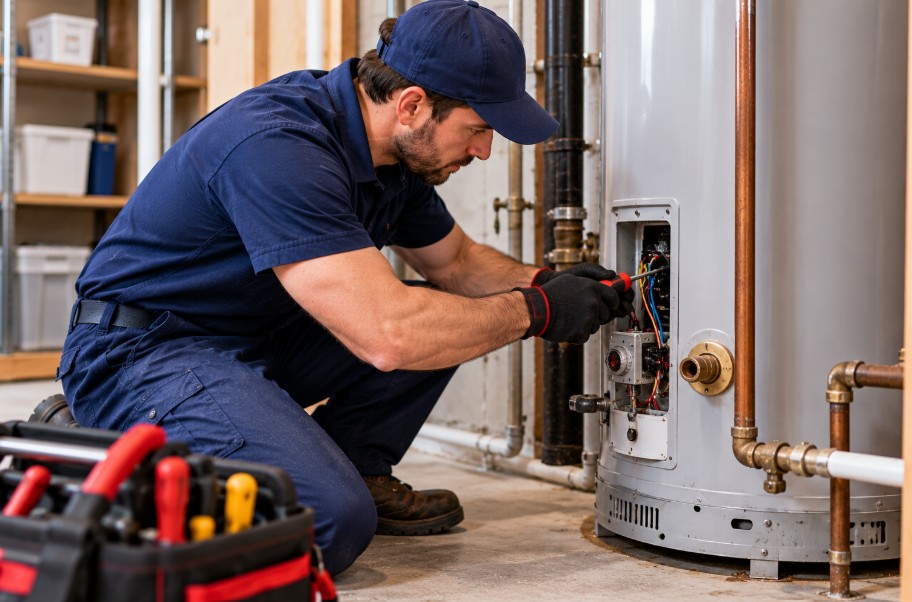
Greensboro's water is soft, so the scale that ruins water heaters in other cities is not the main problem here. Age, sediment, high pressure and cold crawl spaces are. Most failures are a part, not the tank, and a part can be replaced.
Emergency water heater repair: what to do first
Critical shutoff and safety actions for gas leaks, electrical hazards, and uncontrolled tank water discharge.
| What is happening | Do this now |
|---|---|
| You smell gas | Leave the house. Do not touch light switches. From outside, call 911 or Piedmont Natural Gas at 800-752-7504. Stay out until you are told it is safe. |
| A carbon monoxide alarm is sounding | Leave the house and call 911 immediately. |
| The tank is leaking | Close the cold-water valve above the heater. Switch an electric heater off at its breaker. Turn a gas heater's control to off. |
| The relief valve is releasing hot water or steam | Turn off the power or gas. Keep clear of the discharge pipe and never cap it. |
| The water is scalding | Turn off the power or gas and stop using hot water. A thermostat or gas control has failed. |
| There is no hot water | Check the breaker once, or the status light on a gas heater. Then call. |
Certified Water Heater Technicians
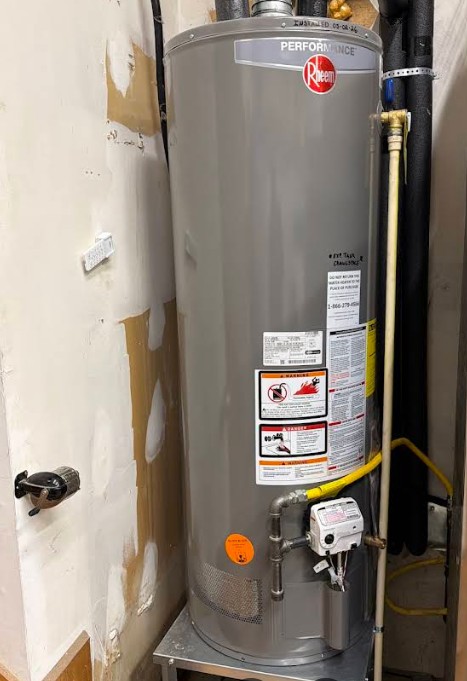
Rapid diagnosis of pilot assemblies, heating elements, expansion tanks, and relief valves across Greensboro.
What the symptom usually means
Compare what you are observing on gas versus electric systems to identify whether the part is repairable.
| Symptom | On a gas heater | On an electric heater | Can it be repaired? |
|---|---|---|---|
| No hot water | Pilot or igniter out, failed thermocouple or flame sensor, bad gas control | Tripped breaker or reset button, burned-out element, failed thermostat | Usually |
| Hot water runs out fast | Sediment, a broken dip tube, a weak gas control | Lower element out, a broken dip tube, sediment | Usually |
| Rumbling or popping | Sediment baked onto the tank bottom | Sediment over the lower element | A flush helps if it is caught early |
| Pilot will not stay lit | Thermocouple, or an air intake screen clogged with lint | Not applicable | Yes |
| Relief valve drips | No working expansion tank, high house pressure, or a worn valve | The same | Yes |
| Rotten-egg smell from hot taps only | The anode rod reacting with bacteria in the tank | The same | Yes, with a different anode and a tank flush |
| Rusty water from hot taps only | Anode used up and the tank lining failing | The same | Sometimes. Often it is the end of the tank. |
| Water on top of the heater | Corroded connections or a leaking relief valve | The same | Yes |
| Water under the heater | A drain valve, or a tank that has rusted through | The same | The valve, yes. The tank, no. |
The water heaters we repair
Full service troubleshooting across all major water heating configurations and fuels.
| Type | What usually fails | Worth knowing |
|---|---|---|
| Gas tank | Thermocouple or flame sensor, igniter, gas control valve, burner assembly, vent connection | A gas heater that keeps going out can be starved of air by lint on its intake screen. |
| Electric tank | Heating elements, thermostats, the high-limit reset, wiring at the junction box | The upper element failing means no hot water. The lower one failing means it runs out fast. |
| Tankless | Igniter, flow sensor, heat exchanger scale, condensate drain, venting | The unit shows an error code. Tell us the code when you call. |
| Heat pump (hybrid) | Air filter, fan, condensate drain, control board | It needs air around it. One boxed into a closet will underperform. |
What is hard on water heaters in Greensboro
Local water chemistry, seasonal municipal disinfection switches, and Piedmont housing layout dynamics.
Sediment, not hardness
The city's water quality reports put hardness in the mid-40s milligrams per liter. That is soft water, and heavy scale is not the usual problem here.
Sediment is. The city explains that iron and manganese settle in its pipes and are stirred up when flow changes during repairs and system work. What comes through your meter ends up at the bottom of the tank. That layer is what rumbles, and it buries the lower element in an electric heater.
Is it the heater or the city's water?
Greensboro disinfects with chloramines and switches to free chlorine for part of each year, most recently from December 7, 2025 to mid-April 2026. The city says customers may notice temporary changes in color, taste and odor.
One test separates the two:
- Cold and hot taps both affected: It is the municipal supply. The heater is not the cause.
- Hot taps only: It is the heater. Rust points to the tank or anode. A rotten-egg smell points to the anode.
Where the heater sits
- Crawl space or garage: The tank loses heat to cold air all winter, and the pipes on top of it are among the first in the house to freeze.
- Garage: North Carolina's plumbing code calls for the ignition source to sit at least 18 inches above the floor, unless the heater is a flammable-vapor-resistant model. Older installations often do not comply.
- Attic: A leak comes down through the ceiling. The pan and its drain line matter more here than anywhere else.
Pressure & Expansion Tanks
The state plumbing code limits house pressure to 80 psi. Where a pressure-reducing valve is fitted, heated water has nowhere to expand, so the code also calls for an expansion tank at the heater.
Those small tanks fail quietly. The first sign is a relief valve that drips every time the heater runs.
Repair or replace?
Honest diagnostics to determine whether repairing a component or investing in a replacement is your smartest financial move.
| What we find | What we advise |
|---|---|
| The tank itself is leaking | Replace. A rusted-through tank cannot be repaired. |
| A failed part on a heater under about eight years old | Repair. |
| A failed part on a heater past about twelve | Get both prices. A repair may be buying one more year. |
| Rusty hot water from an old tank | Replace before it leaks. |
| A second repair within a year | Compare the two repair bills with a new heater. |
| The heater still works but the household has grown | Replace when it suits you, not in an emergency. |
Professional Assessment
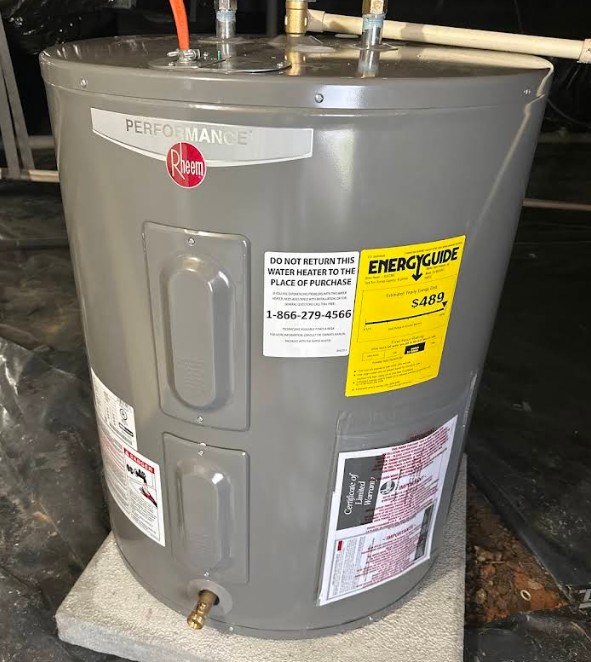
Accurate rating label decoding, age confirmation, and clear repair versus replace estimates on all major brands.
How to tell its age
The rating label on the side of the tank carries a serial number, and the manufacture date is coded into it. Read us the brand and serial number on the phone and we can usually tell you the year.
If it is replaced
Ask for haul-away of the old heater to be on the quote. If you keep it, the city collects large appliances at the curb by appointment through 336-373-2489.
Permits and code in Greensboro
Understanding North Carolina plumbing statutes and local City of Greensboro inspection rules.
When no permit is needed
North Carolina law exempts a replacement in a one- or two-family home when all of these are true:
- A licensed plumbing contractor does the work and checks it on completion.
- The fuel, location and capacity stay the same.
- The energy input is no greater than the old heater's.
- The venting and piping are not rerouted or resized.
- On a gas heater, the gas piping is leak-tested.
When a permit is needed
- Switching from a tank to tankless.
- Changing fuel, from electric to gas or the reverse.
- Moving the heater.
- Installing a larger unit, or changing the vent.
What the code expects around the heater
A replacement has to meet today's code, even if the old installation did not. That commonly means adding:
What affects the cost of a water heater repair
You get a written price before work starts. Four key factors establish the exact quote.
The part
A thermocouple or an element is a small repair. A gas control valve or a tankless heat exchanger is a larger one.
The type of heater
Tankless and heat pump units take longer to diagnose and their parts cost more than traditional storage tanks.
Where it is
A heater in a garage is easy to work on. One in an attic or a tight crawl space takes longer to access and maneuver.
Its age
Parts for older and discontinued models can be harder to source from local supply warehouses.
Making a water heater last
Simple homeowner habits and preventative maintenance steps that add years of reliable service to your water heater.
Flush the tank once a year
Draining a few gallons from the drain valve carries out sediment before it hardens onto the tank floor.
Have the anode rod checked every few years
It is the sacrificial part designed to corrode so the tank lining does not rust through.
Lift the relief valve lever once a year
It should release water and then reseal smoothly. If it drips or fails to seal, it needs immediate replacement.
Set the temperature to 120°F
Hotter water scalds faster and accelerates sediment buildup and internal tank wear.
Check the expansion tank
Tap it. It should sound hollow on top. A tank that is completely solid and full of water has failed.
Keep air intakes clear
Keep a gas heater's air intake screen clear of household lint, storage boxes and stored paint containers.
Insulate pipes before winter
Insulate the pipes above a heater in a cold crawl space or unheated garage before freezing winter temperatures hit.
Clean tankless filters and descale
On a tankless unit, clean the cold water inlet filter and have the heat exchanger descaled according to the manufacturer's schedule.