Burst Pipe Repair in Greensboro, NC: Water Off, Pipe Fixed, Line Tested
A Greensboro plumber reaches most city addresses in about 60 minutes. We stop the water, cut out the split, rebuild the pipe and pressure-test the line before we leave.
- Crawl space, wall, ceiling, slab and yard lines
- The whole run checked for a second split
- Written price first, same rate at any hour
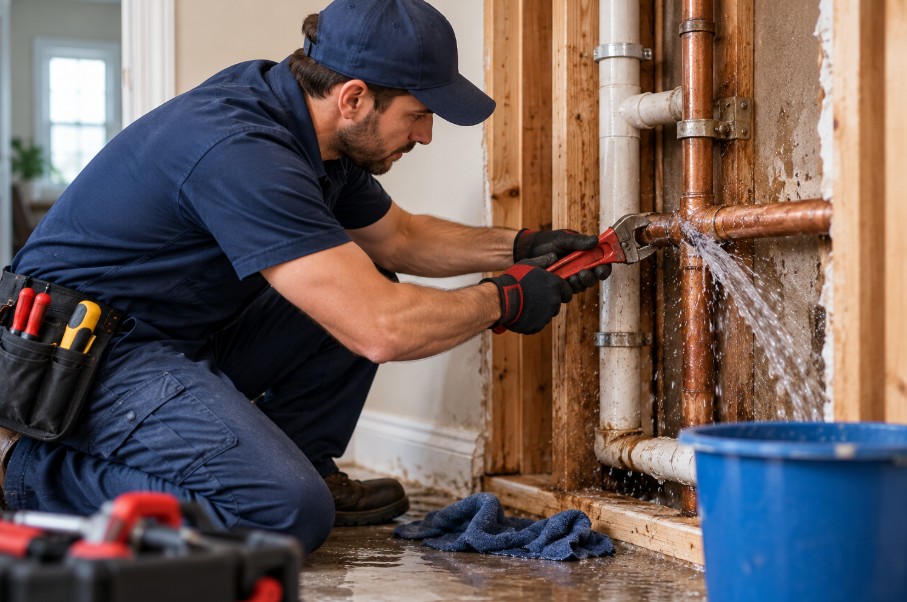
Pipe burst right now? The first ten minutes
The water does the damage, not the pipe. Stop the flow first and everything after that gets smaller.
Close the main valve
A lever handle closes with a quarter turn, until it sits crosswise to the pipe. A round wheel handle turns clockwise until it stops.
If the valve will not turn, do not force it
Old wheel valves snap at the stem. Call us and we will shut the water at the meter box by the street.
Open taps downstairs & upstairs
Open a cold tap downstairs and one upstairs. The lines drain through the taps and the spray at the break dies off within a minute or two.
Switch off electrical power
Switch off power to any room where water has reached lights, outlets or the panel. Do it at the breaker, standing on a dry floor. If water is coming through a light fitting, leave the wall switch alone.
Stand clear of a sagging ceiling
A ceiling that hangs like a belly is holding water and can drop without warning.
Turn the water heater down
Set gas to pilot or vacation. Switch an electric heater off at its breaker.
Film the damage, then start on the water
Thirty seconds of video before the first towel helps any insurance claim.
Leave the heat on
After a freeze, other lines may still be frozen and unbroken.
Where the main shutoff usually hides in a Greensboro house
| Your house | Look here first |
|---|---|
| On a crawl space | Where the line comes up through the floor: a hall or laundry closet, under the kitchen sink, or beside the water heater. In some older houses the only valve is in the crawl space, just inside the access door. |
| On a slab, or a townhome | The garage wall, the water heater closet, or a utility closet near the front of the unit. |
| With a basement | The basement wall that faces the street, low down. |
| Any house | The meter box, set in the ground near the street or sidewalk. |
How we repair a burst pipe
A burst pipe repair is four jobs: stop the water, find every split, rebuild the pipe, and prove it holds.
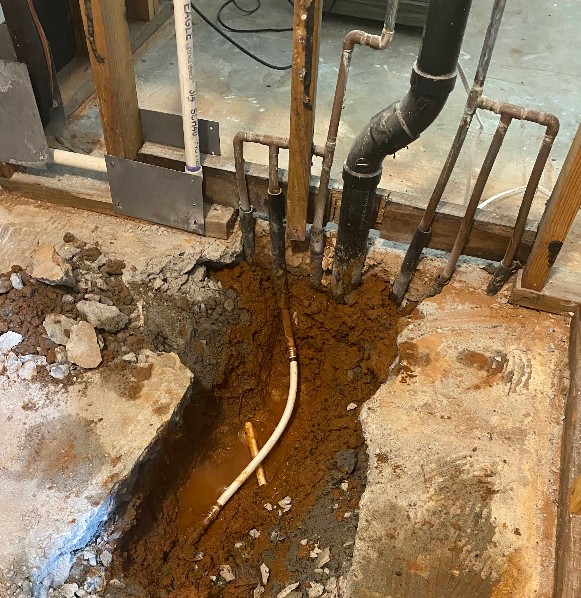
We check the meter, not just the valve handle.
A freeze seldom breaks a line in only one place. We follow the whole run that was exposed to the cold.
A crawl space or garage line needs no cutting. For a pipe in a wall we cut one clean square of drywall that a patch will cover.
A split pipe is stretched thin for several inches either side of the tear. We cut until the pipe is round and full thickness again.
The table below shows what that means for each kind of pipe.
With every fixture closed, your meter has to sit still. Then we walk every room and the crawl space.
A line that froze once in that spot will freeze there again. We price insulation, heat cable or a new route through heated space as a separate option.
You get dated photos, the cause in writing and an itemized invoice. We leave the failed section of pipe with you for your insurer.
The repair depends on the pipe
Different plumbing materials behave differently under freeze pressure and require specialized reconstruction methods.
| Pipe | How to recognize it | How it usually fails | How we repair it |
|---|---|---|---|
| Copper Metallic | Brown or green-tinged metal, soldered joints | Splits lengthwise in a freeze. Pinholes with age. | New copper with soldered or press-fit couplings, or a PEX section joined with transition fittings. |
| Galvanized steel Threaded Metal | Gray metal, threaded joints, a magnet sticks to it | Rusts shut from the inside, then breaks at the threads. Fittings crack in a freeze. | Old threads rarely reseal. We replace the run back to a sound joint, usually in PEX. |
| Polybutylene Gray Plastic | Gray flexible plastic, stamped PB2110 | Pipe and fittings crack with age. It needs no freeze to fail. | A transition coupling to PEX gets your water back on tonight. Then we talk about the rest of the house. |
| CPVC Rigid Plastic | Cream or tan rigid plastic | Turns brittle with age and cracks at fittings when frozen or bumped. | We cut back until the pipe stops crumbling, then join new CPVC or change over to PEX. Glued joints need cure time before full pressure. |
| PEX Modern Flexible | Red, blue or white flexible plastic | The pipe tolerates freezing better than the others. Its fittings and manifolds do not always. | A new fitting or section, crimped or expansion-fitted. |
Why pipes burst in Greensboro
Most burst pipes we repair are freeze breaks. The rest come from old pipe, high water pressure, or both together.
How a freeze actually breaks a pipe
Ice does not usually split the pipe where it forms. An ice plug grows along the line and squeezes the water trapped between it and a closed faucet. Pressure climbs until the weakest point gives.
That point can be several feet from the ice, inside the heated part of the house. It is why a pipe in a warm kitchen wall can burst when the frozen section is out in the crawl space.
It is also why a dripping faucet helps. The drip lets that trapped pressure escape before it shatters the pipe wall.
Building-code guidance from the International Code Council puts the start of trouble at about 20°F outdoors for unprotected pipes. Greensboro reaches that most winters, though not for long.
Wind makes it worse. The front that arrived on December 23, 2022 came in with a 50 mph gust at the airport. Air moving through foundation vents strips heat from a pipe far faster than still air at the same temperature.
Breaks that have nothing to do with cold
Polybutylene
Gray plastic supply pipe from roughly 1978 to 1995. It goes brittle from the inside and lets go at the fittings.
Aging CPVC
The cream-colored plastic that followed it. After twenty-odd years it can crack from a bump or a pressure surge.
Galvanized steel
It rusts inward until the wall is thin, then breaks at a threaded joint.
High pressure
North Carolina's plumbing code caps pressure inside a house at 80 psi and calls for a pressure-reducing valve where the street supply runs higher. Those valves wear out. When one fails, the weak points go first: washing machine hoses, toilet supply lines and old fittings.
Thermal expansion
A pressure-reducing valve closes the system, so heated water has nowhere to expand. The code answers that with an expansion tank at the water heater. When the tank fails, pressure spikes every time the heater fires.
Physical Damage
A screw through a pipe in a wall, or a line knocked loose during crawl space work.
Where pipes burst in Greensboro houses
Tell us the age of the house and what it sits on, and we can usually name the spot before we get there. These are the eight places we look.
| Where | Why it fails there | The Greensboro houses we see it in |
|---|---|---|
| Vented crawl space | Supply lines hang under the floor in outside air. Open foundation vents and a missing access door let the wind through. | Older houses on brick foundations and piers: Glenwood, Lindley Park, and the mill houses at White Oak, Proximity and Revolution. |
| Outside kitchen or bath wall | The sink sits on an exterior wall and its pipes run through the wall cavity, often on the cold side of the insulation. | Postwar ranches off Friendly Avenue and Battleground Avenue. |
| Garage | The water heater, its lines and a laundry sink share an unheated room. One night with the door open is enough. | Houses of any age with the water heater in the garage. |
| Floor of room over garage | Lines to a bonus room or upstairs bath cross an unheated floor cavity above the garage. | Two-story homes from the 1990s and 2000s in Adams Farm, Lake Jeanette and Reedy Fork. |
| Attic | Lines to upstairs baths, or a water heater installed in the attic. A break here comes down through the ceiling. | Homes with second-floor plumbing along the eaves. |
| Outdoor faucet | A hose left connected holds water in the faucet. It splits inside the wall, and you find out in spring when you first use it. | Every part of town. |
| Irrigation backflow assembly | Greensboro requires a reduced pressure zone assembly on every irrigation system. It stands above ground, full of water, and is often the first thing on a property to freeze. | Any home with a lawn sprinkler system. |
| Yard line or slab | Buried lines rarely freeze. They fail from age, and it shows as a wet strip of lawn or a warm patch of floor. | Homes from the 1980s and 1990s with polybutylene service lines, and slab-built townhomes. |
Empty houses are a category of their own
A burst in an empty house runs until someone notices. We see it in three kinds of property:
- Student rentals near UNCG and N.C. A&T: Tenants leave for winter break and turn the heat down or off. The break falls in the coldest weeks of the year.
- Houses for sale: The utilities are on, the thermostat is low and nobody visits for days.
- Homes of people who winter elsewhere: A neighbor sees water at the door or ice on the driveway.
If you own one of these, the prevention advice below matters more than anything else on this page.
When pipes burst here: Greensboro's hard freezes
Greensboro's pipe-breaking cold arrives two ways: one very deep night, or several days that never climb above freezing. The record holds both kinds.
| When | What the record shows |
|---|---|
| Late January 2026 | Lows of 13 to 15°F on January 24 to 26 with ice and sleet. A week later, 10.3 inches of snow on a day that peaked at 25°F. |
| January 2025 | The Triad stayed below freezing for 88 hours straight. |
| December 23 to 26, 2022 | 5°F on Christmas Eve morning, the coldest reading since January 2014. The high that day was 26°F, a record for the date. |
| January 2018 | 202 hours at or below freezing, a Greensboro record. The old mark was 156 hours, set in 1988. |
| February 20, 2015 | 6°F at the airport. |
| January 21, 1985 | 8 below zero, the coldest temperature ever recorded in Greensboro. |
Deep Cold (Single Night)
One night at 5°F catches the exposed lines: crawl spaces, garages, outdoor faucets and backflow assemblies.
Long Cold (Extended Freeze)
A week below freezing does something else. The cold works into wall cavities and deep crawl spaces that ride out a single night without trouble. January 2018 broke pipes in houses that had never had a problem before.
Why the phone rings a day late
While a pipe is frozen, the ice itself plugs the split. Nothing leaks. The water comes when the ice lets go, usually on the first afternoon back above freezing.
So a house can look fine through the whole cold snap and flood on the mild day after it. If a faucet ran dry during the freeze, treat that line as broken until someone has looked at it.
Frozen but not burst yet
A faucet that gives a trickle or nothing on a cold morning means ice somewhere in that line. You have a window to act before it becomes a burst.
How to tell
- One faucet or one side of the house has no water, and the rest works.
- A toilet flushes once and does not refill.
- You can see frost or a bulge on an exposed pipe.
When to call instead
Call us if the frozen section is somewhere you cannot see or reach, if more than one fixture is out, or if the meter moves once water is back. We find the frozen stretch and thaw it with the main valve ready to close, so someone is standing there when a split shows itself.
What to do
Find your main valve before anything else. If the pipe is split, you will need it the moment the ice melts.
Open the faucet on that line, hot and cold. Moving water helps melt the ice, and the open tap gives pressure a way out.
Warm the pipe gently, starting at the faucet end. The Red Cross lists four safe tools: an electric heating pad, a hair dryer, towels soaked in hot water, or a space heater kept well away from anything that burns.
Never use a flame. No torch, no propane or kerosene heater. An open flame in a wall cavity or crawl space is how a frozen pipe turns into a house fire.
Open the cabinet doors and turn the thermostat up. Warm room air has to reach the wall the pipe runs through.
When the water returns, go looking. Check under sinks, along ceilings below, and in the crawl space. Then shut every tap and watch the meter for movement.
Repair the split, replace the run, or re-pipe the house
Most burst pipes need a repair and nothing more. The pipe material and the reason it broke tell you when that stops being true.
| What we find | What we recommend | Why |
|---|---|---|
| One freeze split in sound copper or PEX | Repair the split | The pipe was fine and the cold was the problem. Spend the money on keeping that spot warm. |
| Three or four splits along one crawl space run | Replace the run | A line patched in four places has eight new joints. One new length of PEX has two. |
| Galvanized steel that broke without a freeze | Replace that branch and plan for the rest | The rust that broke it is inside every other piece of the same age. |
| Polybutylene that let go | Repair tonight, then get a re-pipe quote | The next fitting is as old as the one that failed. |
| CPVC that cracks as we work on it | Replace back to pipe that holds, and budget for more | Brittle pipe does not get better. |
| A second burst in a few years with no freeze | Test the pressure before replacing anything | A failed pressure-reducing valve or expansion tank will keep breaking new pipe. |
The 2 A.M. Policy
Nobody should decide on a re-pipe at 2 a.m. with wet socks. We fix the break that night. The bigger question waits for daylight and a written quote you can compare.
Greensboro City Permits
A whole-house re-pipe in Greensboro needs a city plumbing permit and an inspection. A repair that puts back what was there generally does not.
What decides the cost of a burst pipe repair
You get a written price before we cut anything. Four things set it.
Where the pipe is
An open crawl space or garage line is quick to reach. A pipe behind tile, above a ceiling or under a slab is not.
How many splits there are
One break is one repair. A frozen run can have several splits along its length.
What the pipe is made of
Copper and PEX are straightforward. Galvanized and brittle plastic mean replacing more pipe to reach something sound.
How far back we have to go
The repair ends where the pipe is healthy, and that is sometimes several feet from the tear.
What does not change the price
The hour, the day of the week, and the holiday. A burst at 3 a.m. on Christmas Eve is priced like one on a Tuesday afternoon.
What a plumbing quote does not cover
Drying, drywall, flooring and paint are separate work. In most burst pipe losses the plumbing is the small number and the water damage is the large one.
After the water is off: the first 48 hours
The EPA's guidance is to dry water-damaged areas and items within 24 to 48 hours to prevent mold. The clock starts when the pipe breaks, not when the plumber leaves.
EPA 24–48 Hour Window
Mold spores germinate on damp cellulose surfaces within 24 to 48 hours. Quick water extraction and structural drying protect your air quality and claim integrity.
What you can do yourself
- Get the standing water up: Use a wet vacuum, mops and towels. Never use a household vacuum.
- Move air across everything wet: Run fans and a dehumidifier. Keep the heat on in winter and the air conditioning on in summer.
- Protect furnishings: Pull up wet rugs and move furniture off damp carpet. Slip foil or plastic under furniture legs so they do not stain.
- Ventilate millwork: Empty the cabinets under a wet sink or along a wet wall. Leave the doors open.
What usually has to come out
- Carpet pad: Holds water like a sponge and cannot be adequately dried in place.
- Soaked insulation: Loses R-value permanently and breeds mold against framing.
- Ceiling drywall that has sagged: The EPA notes that absorbent materials may have to be thrown away once mold takes hold in them.
The crawl space is the part people forget
In a crawl space house, water from a burst runs down through the floor and pools on the plastic ground cover. The insulation between the floor joists soaks it up and holds it against the subfloor.
Nobody sees it, so nobody dries it. Left wet into a humid Greensboro summer, it becomes a mold problem under the floor. We check the crawl space on every burst pipe call and tell you what we find.
When to bring in a water damage company: We fix plumbing. Drying a soaked house is restoration work with its own equipment. If water came through a ceiling, ran inside a wall or covered more than one room, call a water damage company the same day and tell your insurer you have.
Insurance and your water bill after a burst
We are plumbers, not insurance agents, and your own policy decides what is paid. This is what the state regulator and the city say, and what we do to help.
Homeowners Insurance & The NC Department of Insurance
NC DOI Consumer Line: 855-408-1212Insurers generally treat water damage from a pipe that bursts suddenly and by accident as the kind of loss a homeowners policy is for. Damage that traces back to neglect is a different matter.
"The North Carolina Department of Insurance puts it plainly: Frozen pipes might not be covered if the damage is due to negligence, such as failing to keep the house at an adequate temperature. That is the clause that catches empty houses with the heat turned off."
The Department's advice after winter damage:
Call your insurer promptly and have your policy number ready.
Photograph or film the damage thoroughly before altering anything.
Make temporary repairs to prevent more damage. Stopping the leak comes under this.
Hold off on permanent repairs to the house (drywall, floors, cabinets) until the insurer inspects.
Keep every receipt, including the ones for temporary repairs.
What we give you for the claim
We furnish complete adjusters' evidentiary documentation on every freeze repair call:
Your Greensboro water bill adjustment
A burst line runs through the meter, so the water shows up on your next bill. Call the city's contact center at 336-373-2489 during business hours, explain what happened, and ask whether the bill can be reviewed. Have your repair invoice in hand.
GSO WaterWise Portal: Greensboro's customer portal shows daily water use and sends real-time leak notifications. If you own a house that sits empty, sign up. A burst that reaches your phone in an hour costs far less than one a neighbor notices on day three.
The city has also partnered with SLWA, which sells optional protection plans for outside lines. We have no connection to it, but it is worth knowing about if your yard line is original to an older house.
If you rent in Greensboro
The building is your landlord's to insure and repair. Your furniture, clothes and electronics are covered only if you carry renters insurance.
If water is spraying, shut off the main valve immediately and notify the landlord or property manager in writing right after.
Your pipe or the city's?
The City of Greensboro repairs leaks up to your property boundary. From there to the house, the line is yours. Two minutes at the meter tells you which side the break is on.
The 2-Minute Water Meter Diagnostic
Follow these five steps to isolate whether the failure is city responsibility or on your private line:
Look at where the water is: Water coming up in the street, at the curb or around the meter box points to the city side. Call Water Resources 24-hour dispatch at 336-373-2033.
Close the main valve at the house. Then lift the meter box lid at the curb and watch the dial or digital flow rate indicator.
If the reading still moves: Water is escaping between the meter and the house. That is your service line, and it is a repair we do.
If the reading stops: The leak is inside the house, past the shutoff valve you just closed.
If you and your neighbors all have no water: It is likely a city distribution main break. Dispatch at 336-373-2033 can tell you.
Keeping it from happening again
Most freeze breaks in Greensboro are preventable with an afternoon of work in November and ten minutes on the night of a hard freeze.
Before winter
- Take hoses off every outdoor faucet: Do it by early November, before the first hard frost.
- Swap for frost-free sillcocks: The valve seat sits inside the heated wall, so no water is left in the freezing exterior zone.
- Insulate crawl space lines & latch access door: Closed foam sleeves cost little. A crawl door left off its hinges undoes all insulation.
- Install thermostatically controlled heat cable: Put listed heat cable on any line that has frozen before.
- Winterize sprinkler backflow assembly: Drain and insulate backflow assemblies. Any repair must be tested by a city-approved tester.
- Upgrade to a quarter-turn ball valve: If your main shutoff is a stiff old gate valve, replace it before an emergency forces the issue.
On a night forecast at 20°F or below
- Drip faucets on outside walls: Run a steady pencil-lead drip on exterior wall fixtures and the faucet farthest from the main entrance.
- Open cabinet doors: Let heated room air circulate around sink supply lines in kitchens and guest baths.
- Keep garage doors closed: Essential if your water heater or primary distribution lines pass through the garage.
- Hold thermostat steady overnight: Setting temperatures back saves pennies but triggers pipe freezes during the coldest pre-dawn hours.
If the house will be empty
- Leave the heat on: The American Red Cross specifies keeping thermostats no lower than 55°F.
- Drain lines for extended trips: If gone for more than a few days, shut the main valve, open taps to drain, and set water heaters to vacation.
- Schedule walkthroughs during freezes: Have a neighbor or manager walk the house after any night in the teens (vital for student rentals).
- Turn on GSO WaterWise notifications: Immediate automated phone/email alerts when unusual continuous meter activity is logged.
All year
- Check static water pressure: A hose bibb gauge costs very little. Readings over 80 psi require servicing or replacing the PRV.
- Upgrade washing machine hoses: Replace standard black rubber hoses with braided stainless steel lines that resist bursting.
- Know your pipe materials: If your home contains gray polybutylene, plan an orderly re-pipe before sudden joint degradation forces it.
FAQs
Clear answers on burst pipe repair timelines, DIY temporary caps, freeze dynamics, pricing, and Greensboro municipal permits.
How long does a burst pipe repair take?
It depends on where the pipe is. A split you can see in a crawl space or garage is a short job. A pipe behind tile, above a ceiling or under a slab takes longer, and we tell you how long before we start.
Can I patch it myself until morning?
Sometimes. If the split pipe is exposed, cutting it square and pushing on a push-to-connect cap can bring water back to the rest of the house. Tape and epoxy putty rarely hold line pressure for long. If you are unsure, leave the main valve closed.
The pipe burst in a heated room. How did it freeze?
It probably did not freeze there. Ice formed in a colder stretch of the same line and pushed the pressure up until the pipe gave way at its weakest point, which was indoors.
It was not even that cold. Why did my pipe burst?
Then cold was not the cause. Look at the pipe material and the water pressure. Polybutylene, old CPVC, rusted galvanized steel and a failed pressure-reducing valve all break pipes in mild weather.
Will it burst in the same place again?
If nothing changes, yes. The repaired joint is stronger than the old pipe, but the cold air reaches the same spot. That is why we price insulation or a new route with the repair.
My outdoor faucet or sprinkler backflow split. Is that an emergency?
Not if you can isolate it. Close the valve that feeds it and the rest of the house carries on. If there is no valve, or it will not close, call.
Do you repair burst pipes under a slab or out in the yard?
Yes. Those are different jobs with their own pages on this site: slab leak repair and main water line repair.
Does a burst pipe repair need a permit in Greensboro?
A repair that puts back what was there generally does not. Replacing the water service line or re-piping the house does, through the city's Engineering & Inspections department. We file it when it applies.
The house is empty and a neighbor has seen water. What now?
Ask the neighbor to close the valve at the house if they can reach it, then call us. We can shut the water at the meter and stop the damage. Getting inside to repair the pipe needs you or someone with a key.
Cannot find your main shutoff valve?
Call us right away and a licensed plumber will talk you to it or shut it at the street meter box.
