
Drain Cleaning in Greensboro, NC: Emergency Drain Cleaning at Any Hour
A slow kitchen sink, a tub that will not empty, or sewage rising in the lowest drain of the house. We clear the line, find out why it clogged, and tell you plainly whether it will come back.
- Sinks, tubs, showers, toilets, floor drains and main sewer lines
- Emergency calls answered at any hour, at the same rate
- A written price before any work starts
Sewage coming up in a tub or floor drain? Stop running water anywhere in the house, then call.
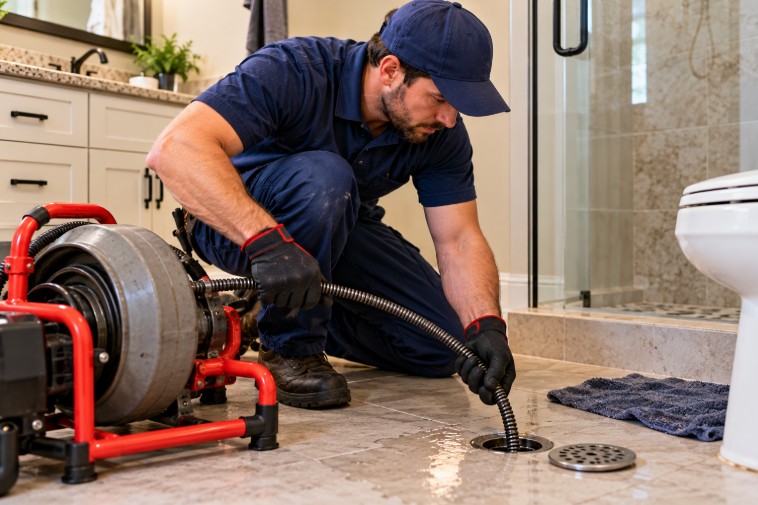
Most Greensboro drain clogs come down to four things: tree roots in old clay sewer lines, kitchen grease, wipes caught on rough cast iron, and now and then a backup in the city's own main.
We clear the clog and tell you what caused it. If the whole house is backing up, stop using water and call immediately.
Drain backing up right now? Do this first
When wastewater stops flowing down and starts pushing up, what you do in the first few minutes protects your flooring, subfloor, and indoor air. Follow these 7 steps in exact order.
Stop running water
Every flush, shower and load of laundry adds to the backup. With the line blocked, whatever goes down one drain comes right up in another.
Stop the washing machine and dishwasher mid-cycle
They pump out on their own under pressure. Cancel the cycle or press pause before hundreds of gallons push into your lowest fixtures.
Do not pour in chemical drain cleaner
It sits in the standing water, does not clear severe main obstructions, and makes the line dangerous to open. If you already used some, tell us so our technicians can take precautions.
Keep children and pets away from sewage
Blackwater carries harmful bacteria, biohazards and parasites. Close bathroom doors and seal off the affected areas until sanitized.
Find the outside cleanout
It is a capped white (PVC) or black (ABS) pipe located near the foundation or out toward the street. Clear a path to it so it is instantly accessible.
If sewage is rising indoors, loosen that cap slowly
Always stand to one side when unscrewing the cleanout plug. Releasing hydrostatic pressure allows the backup to spill into the yard instead of destroying interior hardwood, carpets, or drywall.
Call the city as well as us when the whole house is backed up
Greensboro Water Resources 24-hour dispatch is 336-373-2033, and the city checks whether its own main in the street is blocked.
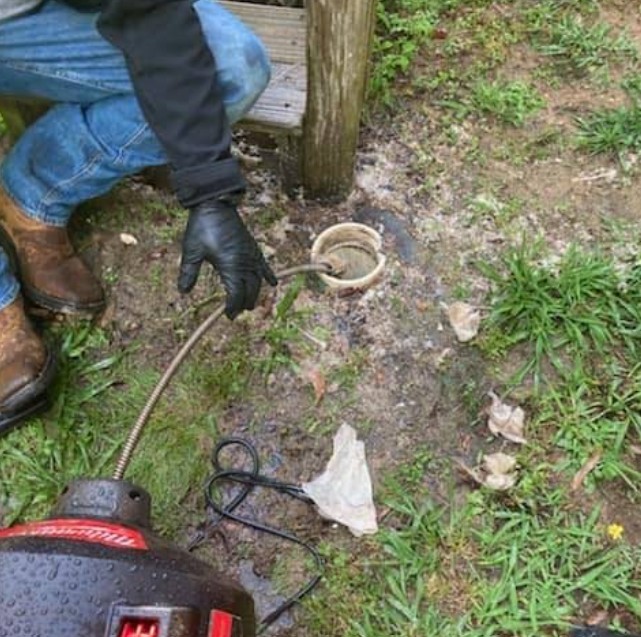
Line Blocked? We Dispatch Fast
From heavy-duty mechanical augers to high-pressure hydro-jetting and sewer camera inspections, we open stopped drains without guesswork.
When a clogged drain is an emergency
Not every stoppage demands an after-hours call, but some cannot wait till sunrise. Match what you are seeing to the right level of urgency.
Call now, at any hour
- Sewage coming up in a tub, shower or floor drain
- Every drain slow and toilets gurgling
- The only toilet in the house is blocked
- Water backs up indoors whenever the washer drains
Call for a same-day visit
- One sink or tub fully blocked while the rest of the house works
- A kitchen sink that will not drain before guests arrive
- A clog that came back within days
Book a visit
- A drain that is slow but still empties
- A smell or gurgle that comes and goes
- A line you want cleaned or looked at before it backs up
One drain or the whole house?
Which fixtures are affected tells you where the clog is. Use this reference to understand how far down the line the restriction sits.
| What you see | Where the clog is |
|---|---|
| One sink, tub or toilet is slow and everything else is fine | In that fixture's trap or the short branch behind it |
| Two fixtures in the same bathroom back up together | In the branch line serving that room |
| The tub or floor drain fills when a toilet is flushed | In the main line |
| A toilet bubbles when the washing machine drains | In the main line |
| The lowest drains in the house back up first | In the main line, or in the city's sewer |
What the outside cleanout tells you
Take the cap off the cleanout and look in to instantly isolate the blockage:
-
Standing water in the pipe
The blockage is farther out, between the cleanout and the street. The sewer lateral is backed up toward the public main.
-
Dry pipe while house is backed up
The blockage is between the house and the cleanout. The building drain or main collection run under the foundation is stopped.
The drains we clean
Different drains face different types of debris and require specialized tooling. Here is how we clear each line in a Greensboro home.
| Drain | What usually clogs it | How it is cleared |
|---|---|---|
| Kitchen sink and disposal | Grease, food scraps, coffee grounds, rice and pasta | Cable through the trap arm or cleanout. Water jetting for a line coated in grease. |
| Bathroom sink | Hair, soap and toothpaste | Stopper and trap removed, then a hand cable. |
| Tub and shower | Hair bound up with soap | Cable through the overflow or the drain. |
| Toilet | Wipes, too much paper, a dropped object | Toilet auger. The toilet is lifted if something solid is lodged. |
| Laundry drain | Lint and detergent residue | Cable down the standpipe. |
| Floor and basement drains | Sediment, or a main line backing up into them | Cable, then a check of the main line. |
| Main sewer line | Roots, grease, wipes, or a sagging or broken pipe | Large cable with a cutting head from the cleanout, jetting, and a camera. |
| Yard drains and downspout lines | Leaves, mud and roots | Cable or water jet. |
| Roof vent | Leaves or a nest, heard as gurgling drains | Cleared from the roof. |
What clogs drains in Greensboro
Greensboro's historic neighborhoods, red Piedmont clay, and aging sewer architecture create unique drain challenges.
Grease
Greensboro Water Resources says fats, oils and grease cool, solidify and cling to sewer pipes, restricting the flow. The same happens in the line under your kitchen sink, only sooner.
Tree roots in old sewer lines
The city says most of its water and sewer lines were installed before the 1950s, some before 1910. Removing roots that cause blockages is one of the stated reasons for its sewer rehabilitation program.
The private line from an older house to the street is the same age, under the same trees. Roots enter at the joints, catch paper and grease, and close the pipe. Cutting them out restores flow. It does not stop them growing back.
Wipes, paper towels and debris
The city reported 44 sewer overflows in 2020. Debris in the line was the cause it named most often, ahead of heavy rain and pipe failures.
If debris can stop a city main, it can stop the much smaller line leaving your house. Wipes labeled flushable do not break down the way toilet paper does.
Clay soil
Pipe laid in Piedmont clay settles as the ground swells and shrinks. A low spot, called a belly, holds water and solids after every flush. Cleaning clears a belly for a while, and then it fills again.
Heavy rain
Heavy rain was behind eight of the overflows the city reported in 2020. Rainwater gets into cracked pipes and overloads them.
A cracked private line takes in groundwater the same way. That is why some backups only show up during a long rain.
Leaves
In autumn, yard drains, driveway drains and buried downspout lines fill with leaves and mud. These carry rainwater, not sewage, and they are the property owner's to keep clear.
The pipe itself
About one Greensboro home in five was built before 1960, going by Census figures. The original pipe materials behave differently as they age:
- Cast iron: Roughens inside as it rusts and snags whatever passes.
- Clay tile: Was laid in short lengths, and every joint is a way in for tree roots.
- Galvanized steel: Kitchen and tub drains close up with rust and mineral scale until little opening is left.
- PVC: Smooth in newer homes, but a poorly bedded or shifting line can still sag and form a belly.
How a drain is cleaned
Clearing a drain correctly means following a methodical sequence to protect pipe walls, completely open the blockage, and verify the line holds full flow without backing up.
Find where the clog is
We ask which fixtures are affected, run water at each, and check the cleanout.
Pick the way in
The outside cleanout is best for a main line. Without one, the line is reached through a pulled toilet or the roof vent. A fixture clog is reached through its trap.
Clear it with the method that suits what is in the pipe
Whether heavy root cutting, mechanical snake, or hydro-jet scouring, the tool matches the obstruction.
Prove it
A cleared line has to take a full tub of water and several flushes without backing up.
Look inside when there is reason to
After a main line backup or a repeat clog, a camera shows why it happened.
Tell you what came out
Roots, grease or wipes on the cable is the cause, and it decides what happens next.
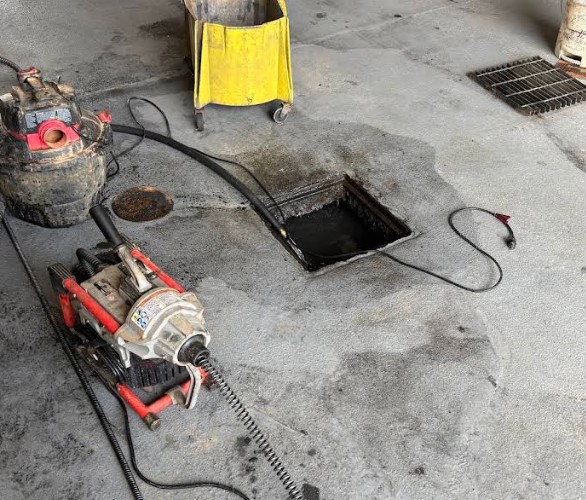
Dedicated Mechanical Drain Tooling
From compact trap cables to continuous-feed auger machines and high-velocity water jetting units, lines are cleared to their full interior diameter.
Drain cleaning methods
Different clogs respond to different tools. Here is how each method works, when it is selected, and its functional limitation.
| Method | What it does | Best for | Its limit |
|---|---|---|---|
| Hand auger | A short cable worked by hand | Sink, tub and toilet clogs close to the fixture | Reaches only a few feet |
| Drain machine | A motor turns a long cable with a cutting head | Most branch and main line clogs, including roots | Bores a hole through grease but leaves the coating. Roots grow back. |
| Water jetting | High-pressure water scours the full pipe wall | Grease, sludge and root hair left after cutting | Needs a cleanout and sound pipe. Old lines are looked at with a camera first. |
| Camera inspection | Shows the inside of the pipe and where the trouble is | Main lines and clogs that keep returning | Only useful once water is flowing again |
When cleaning is not enough
Drain cleaning restores flow. It does not repair a pipe. If the same line clogs again within months, the pipe is the problem.
| What the camera shows | What it means | What can be done |
|---|---|---|
| Roots coming through the joints | They grow back after every cleaning | Scheduled cleaning, or replacing that section |
| A belly holding water | Solids settle there after every flush | Cleaning buys time. Regrading the pipe fixes it. |
| A joint that has shifted or dropped | Paper catches on the lip | Spot repair |
| Cracked or collapsed pipe | The line is failing | Repair or replace the line |
| Cast iron rotted along the bottom | Waste is leaking into the ground | Replace that run |
Repairs to the line are covered on our sewer line repair page. Replacing a sewer line in Greensboro needs a city plumbing permit and an inspection.
Your drain or the city's sewer?
The drains in the house and the service line that carries them toward the street belong to the property owner. The sewer main belongs to the city. A whole-house backup can start in either one.
| What is happening | Call |
|---|---|
| One fixture or one room is blocked | A plumber |
| The whole house is backing up | A plumber, and Water Resources 24-hour dispatch at 336-373-2033 |
| Sewage is coming out of a manhole | Water Resources dispatch, 336-373-2033 |
| A street storm drain or culvert is blocked | The city contact center, 336-373-2489 |
What the city does about a backup
City staff check and clear the sewer main. They also look at the cleanout at the edge of the right-of-way, if your property has one. If no water is standing in it, or no cleanout can be found, the city's position is that the owner must hire a plumber.
The city has asked Triad plumbers to push a blockage all the way to the main, not stop at the cleanout, and to video the line afterward. Ask for both from any plumber you hire. It is the record you will want if the main turns out to be the cause.
Greensboro's sewer backup policy
Since February 1, 2021, the city may reimburse damage from a backup when all four of these are true:
- 1 A blockage in the city's main caused it, not your service line.
- 2 It is the first backup at the address since that date.
- 3 You sign a release.
- 4 You agree to install and maintain a backwater valve.
Backwater valves
A backwater valve lets sewage flow out of the house and blocks it from coming back in. North Carolina's plumbing code calls for one where fixtures sit lower than the next manhole upstream. The city recommends cleaning and maintaining the valve at least once a year.
Storm drains are a different system
The city's storm drains carry rain from streets and gutters straight to streams and lakes, untreated. They do not connect to the sanitary sewer.
Homes on septic
Some homes at the edges of Guilford County are on septic tanks. Tell us if yours is. A full tank or a failed drain field backs up the house just like a blocked sewer, and cleaning the line will not cure it.