
Water Leak Repair in Greensboro, NC: Found, Fixed and Tested
A stain on the ceiling, a warm patch of floor, or a water bill that jumped for no reason. We trace the leak to its source, repair it, and prove the line holds before anything is closed up.
- Leaks in walls, ceilings, floors, slabs and yard lines
- Active leaks handled at any hour, at the same rate
- A written price before any work starts
Water coming through a ceiling or across a floor? Close the main valve first, then call.
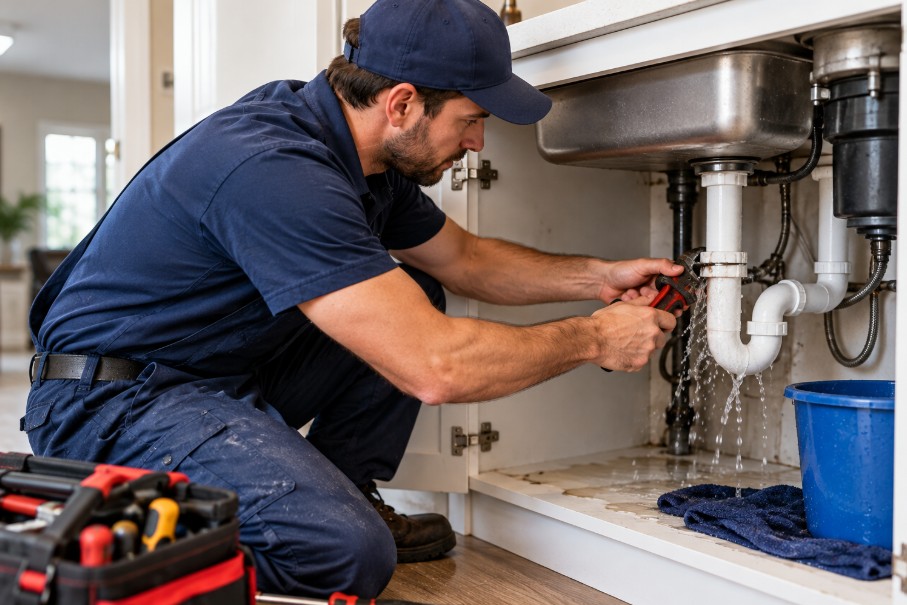
Most water leaks in Greensboro homes are not dramatic. A fitting weeps inside a wall. A gray plastic line seeps behind a cabinet. A yard line loses water into red clay where nobody looks. Often the first sign is the city water bill.
This page covers how to tell whether you have a leak, what to do in the first few minutes, how a leak is found without taking the house apart, and how it is repaired. If water is pouring out right now, close your main valve and call.
Found a leak? What to do right now
Most leaks give you a few minutes to think. Use them in this order.
Sinks and toilets have a small valve on the wall or floor beneath them. The washing machine has two behind it, and the water heater has one on its cold inlet. Turn it clockwise, or a quarter turn if it has a lever.
If that does not stop it, close the main valve. Our burst pipe repair page shows where it usually is in a Greensboro house (crawl space wall, garage, or front basement corner).
Keep water and electricity apart. If water is near outlets, a light fitting or the panel, switch that circuit off at the breaker from a dry spot.
Put a bucket under a drip and move rugs, boxes and furniture out of the wet area before moisture soaks into subflooring.
Take photos and write down the time. Note your meter reading too, if you can get to it safely at the street curb.
If the fixture valve stopped it, you have turned an emergency into an appointment. The rest of the house still has water.
When a leak is an emergency
Not every leak requires a midnight truck. Here is how we categorize urgency when you call.
Call now, at any hour
- Water you cannot stop with any valve
- Water coming through a ceiling or a light fitting
- Water near the electrical panel or outlets
- Hot water leaking from the heater or a hot line
Call for a same-day visit
- A leak you stopped at the fixture, in the only bathroom or the kitchen
- A warm or damp patch on the floor
- The sound of running water with everything off
- A wet strip of yard that keeps growing
Book a visit
- A slow drip under a sink that a bucket is catching
- A toilet that keeps running
- A dripping outdoor faucet
- A higher water bill with no water in sight
Signs of a hidden leak
Most of the leaks we repair were never seen as dripping water. The owner noticed something else first.
Water use that is higher than last month with no change in the household.
A hiss or the sound of running water when every tap is off.
A stain, bubbling paint, soft drywall, or a baseboard that has swollen or pulled away.
A warm patch on a concrete floor, hardwood that has cupped, tiles that have come loose, or damp carpet.
A musty closet or cabinet that never airs out.
Pressure that has dropped at one fixture or through the whole house.
A heater that seems to run all the time, which points to a leak on the hot side.
A soggy or unusually green strip between the meter and the house in dry weather.
Standing water on the ground cover, or insulation that drips.
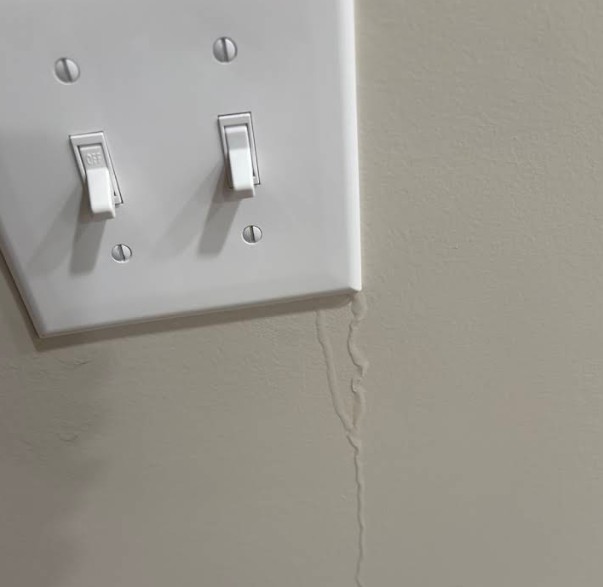
Water seeping near an outlet or switch requires cutting power at the main breaker before touching fixtures.
The meter test
Your water meter is the one instrument that cannot be fooled. This check uses the EPA's method and Greensboro Water Resources' own advice.
Turn off everything that uses water. That includes the ice maker, the washing machine and the sprinkler controller.
Read the meter, wait two hours, and read it again. If the reading changed and nobody used water, there is an active leak.
Now close the main valve at the house and watch the meter again. If it still moves, the water is escaping between the meter and the house. If it stops, the leak is inside.
Test each toilet with food coloring. Put a few drops of food coloring in the tank and wait ten minutes without flushing. Color in the bowl means the flapper is leaking.
Greensboro Water Resources Note: The city names the worn toilet flapper as the most common household leak in Greensboro. It is also the cheapest one to fix.
The sudden high water bill
Understanding Greensboro municipal billing structures and how hidden leaks drive up costs.
Why a leak is charged twice
The city bills water every month in units of 748 gallons. The volume charges for both water and sewer are based on the water that passed through your meter. So leaked water is charged twice, once on each line of the bill.
Per single billing unit
Wasted yearly by avg. leaky home
Lost by 1 in 10 homes (3.5 units/mo)
Greensboro Water Resources reports that one home in ten is losing 90 gallons or more a day without knowing it. Ninety gallons a day is about three and a half billing units added to your statement each month.
Two things to check first
Two things are worth checking before you assume the worst:
- Was the reading estimated? The bill marks each meter reading A for actual or E for estimated. A catch-up after an estimated month can look like a spike.
- What does GSO WaterWise show? The city's customer portal displays daily water use and sends real-time leak notifications. Steady use on days when nobody was home is a leak.
For questions about the bill itself, the City of Greensboro contact center is available at 336-373-2489.
The water leaks we repair
Where the water shows up tells us most of what we need to know about where it started.
| Where the leak is | What you notice | Where it usually starts |
|---|---|---|
| Inside a wall | A stain, soft drywall, a musty smell or a faint hiss | A supply line or fitting in the wall cavity, or the body of a shower valve |
| Above a ceiling | A brown ring under a bathroom, or a drip at a light fitting | A supply line or toilet connection upstairs, or a water heater in the attic |
| Under a floor | Cupped hardwood, damp carpet, a wet crawl space | A line under the floor, or the supply to a refrigerator, dishwasher or toilet |
| Under a concrete slab | A warm or damp patch, the sound of water, a meter that never stops | A hot or cold line buried in or below the slab |
| In the yard | A soggy strip, low pressure, a bill that jumped | The private water line between the meter and the house |
| At supply lines & shutoff valves | A drip under a sink or behind a toilet, green crust on a valve | A braided connector, a compression nut or the valve stem |
| At the water heater | A drip on top of the tank, a rust trail, water in the pan | The inlet and outlet connections, the relief valve or the drain valve |
| At a fixture | A toilet that runs, a faucet that drips, a tub spout that will not shut off | A flapper, fill valve or faucet cartridge |
| Outdoors | A dripping hose faucet, a wet spot near a sprinkler head | The faucet itself, or an irrigation line or valve |
What causes water leaks in Greensboro homes
A leak is nearly always one of six things: old pipe, a tired connection, too much pressure, moving ground, a past freeze, or damage.
The age of the pipe
Census figures put about one Greensboro home in five before 1960, and more than 37,000 housing units in the 1980s and 1990s. Those two groups leak for different reasons:
- Galvanized steel: In oldest houses, rusts from inside until seams weep.
- Copper: Develops pinholes with age, often in hidden cavities.
- Polybutylene (1978–1995): Turns brittle and seeps at its fittings.
- CPVC: Cream plastic that cracks at glued joints as it ages.
Connections, not pipe
More leaks start at a joint than in the middle of a pipe. Solder joints, crimp rings, threaded fittings and compression nuts all have a working life. So do the rubber washers inside braided supply hoses and the seats inside shutoff valves.
Water pressure
North Carolina's plumbing code limits pressure inside a house to 80 psi. Where the street supply runs higher, a pressure-reducing valve holds it down. When that valve wears out, every connection in the house is pushed harder than it was built for.
Red clay that moves
Most of the city sits on Piedmont clay. It swells when it is soaked and shrinks in a dry spell, and the North Carolina Geological Survey notes that expansive soils can turn up anywhere in the Piedmont. Buried water lines and pipes under slabs get flexed with every cycle.
A freeze that did not finish
A hard freeze does not always burst a pipe. Sometimes it opens a hairline split that weeps for months. These turn up in crawl spaces and outside walls long after the cold snap that caused them.
Accidental damage
A screw through a pipe when a shelf goes up. A line nicked during a remodel. A supply hose kinked behind a refrigerator that was pushed back too hard against the wall.
How a leak is located
A leak is narrowed down from the whole house to one spot before anything is opened.
Questions first: When did you notice it? Is the wet area warm? What does the bill history show? Is the house on a crawl space or a slab?
Confirm it at the meter: With everything off, the meter says whether water is still leaving the closed system.
Split the system in halves: Closing the house valve separates the yard line from the house. Closing the water heater's inlet separates hot from cold. Each valve rules out half of what is left.
Test what is left under pressure: A test gauge on the isolated section proves whether that specific loop holds pressure.
Follow the water: We look in the crawl space, the attic and under every sink, and map damp walls and floors to their wettest point.
Pinpoint, then mark it: Modern diagnostic instrumentation puts the leak within a small, precise area before anything is opened.
Explain and quote: You see where the leak is and what the repair involves before any cutting or digging begins.
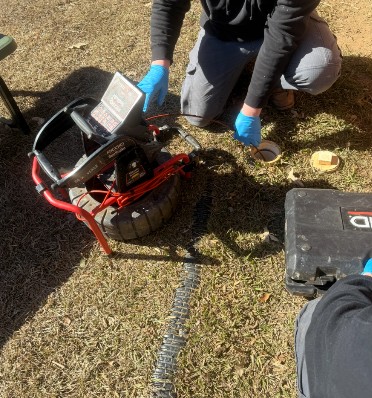
Leak detection methods and what each one is for
We match the technology to the pipe material and building construction.
| Method | What it does | Where it is used |
|---|---|---|
| Meter and valve isolation Standard Baseline | Separates yard from house and hot from cold | Every leak |
| Pressure test Hydrostatic Verification | Shows whether a closed section of pipe holds pressure | Confirming a leak, and proving the repair |
| Moisture meter Moisture Mapping | Reads how wet drywall, wood or flooring is, so the wettest point can be mapped | Walls, ceilings and floors |
| Thermal imaging Infrared Heat Delta | Shows surface temperature differences left by hot water or evaporating moisture | Hot lines in slabs and walls |
| Acoustic listening Ground Microphones | Amplifies the sound of water escaping a pressurized pipe | Slab leaks and buried lines |
| Tracer gas Micro-Sniffer | A safe gas mix is put into the drained line and a detector finds where it surfaces | Buried leaks too quiet to hear |
| Line locating Electromagnetic Induction | Traces the route and depth of a buried pipe | Yard lines |
| Inspection camera Borescope | A small camera through a finger-sized opening | Wall and ceiling cavities |
| Dye test Visual Tablet | Color in the tank shows water slipping past the flapper | Toilets |
How We Repair Water Leak in Greensboro Home
The repair depends on what failed and where it is.
A leaking connection
A weeping joint, a shutoff valve that drips at the stem, a supply hose with a rusted collar. The part is replaced. This is the most common leak repair and the quickest.
A pinhole or split in the pipe
The damaged section is cut out back to clean, round pipe and a new piece is joined in. Copper is repaired in copper or changed over to PEX. Old plastic is cut back until it stops crumbling.
A leak inside a wall or above a ceiling
Once the spot is marked, one opening is cut, sized so a patch will cover it. The pipe is repaired through that opening. The cavity should stay open until it has dried, because closing damp framing behind new drywall is how mold starts.
A leak under a slab
There are three ways to fix it:
- Direct spot repair: Open the floor at the leak and repair that spot. Suits a single break in sound pipe.
- Overhead re-route: Run a new line through walls, attic or crawl space and abandon the pipe under the concrete.
- Complete line replacement: Replace lines altogether when the same slab has leaked more than once.
A leak in the yard line
A single break is dug up and repaired where it is. A line with several weak points, or one made of a material known to fail, is replaced from the meter to the house. Replacement needs a city plumbing permit, and buried utilities are marked through NC 811 before any digging.
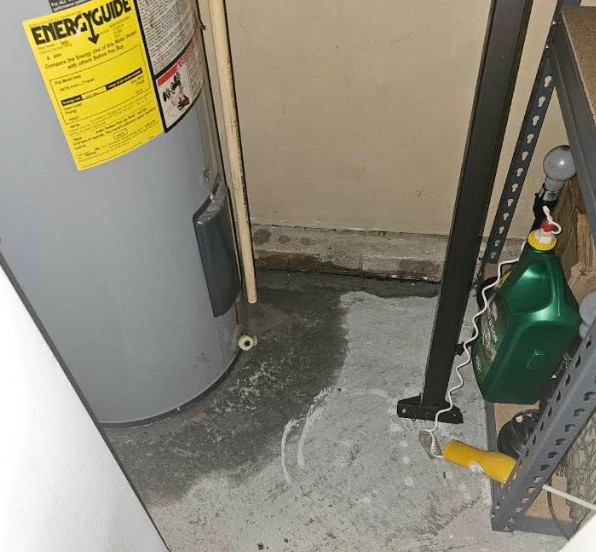
A leak at the water heater
Leaks at the pipe connections, the relief valve or the drain valve can be repaired. Water coming from the tank body itself cannot. That tank has rusted through and needs replacing.
How every repair ends
The water goes back on, the pressure comes up, and the repair is watched until it is bone dry. Then every tap is closed and the meter is checked. If the meter is still, the leak is fixed.