
Leak Detection in Greensboro, NC:
Hidden Leaks Pinpointed, Not Guessed At
A water bill that doubled, a meter that never stops, a damp patch with no source. We trace hidden leaks in walls, under slabs and across yards, mark the exact spot, and put the findings in writing.
- Walls, ceilings, slabs, yard lines and irrigation
- Emergency leak detection at any hour, at the same rate
- Findings in writing, ready for a repair quote or an insurer

Most leaks we are called to find have already been looked for. The owner has checked under the sinks, sniffed the closets and lifted the toilet lid. A hidden leak is hidden because it is inside something: a wall, a slab, or three feet of red clay.
Leak detection or leak repair: which do you need?
| What you have | What you need |
|---|---|
| Water dripping from a pipe, valve or fixture you can see |
Repair See our water leak repair page. |
| A pipe that has split and is spraying |
Emergency Emergency burst pipe repair |
| A stain, damp patch or musty smell with no visible source |
Locate First Leak detection first |
| A high bill, or a meter that moves with everything off |
Locate First Leak detection first |
| A warm spot on the floor, or the sound of water running |
Locate First Leak detection first. It is likely under the slab. |
| A soggy strip of yard |
Locate First Leak detection, to establish whether the line is yours or the city's |
Emergency leak detection
A hidden leak becomes an emergency when it is doing damage you can see but cannot stop.
When To Call Immediately
- Water is coming through a ceiling or a light fitting, and nothing above it looks wet.
- A wall or floor is getting wetter by the hour.
- The meter is turning fast with every tap closed.
- A floor is warm and you can hear water under it.
- Water is near the electrical panel or outlets.
While you wait
What a leak detection visit includes
Each step rules out part of the plumbing until one spot is left.
History
When it started, what the bills show, how old the house and its pipes are, whether it sits on a slab or a crawl space, and what work was done recently.
Confirmation
With every fixture closed, the meter shows whether water is leaving the system and roughly how fast.
Isolation
The house valve separates the yard line from the house. The water heater inlet separates hot from cold. Fixture valves rule out each fixture.
Pressure test
A gauge on the suspect section shows whether it holds or drops.
Scan and listen
The wet area is mapped, and the pipe route is checked with the methods below.
Pinpoint and mark
The spot is marked on the floor, wall or ground, with the depth for a buried line.
Written findings
You get the location, the methods used, photos and images, the likely cause, and the repair options.
Leak detection methods
Custom Tool Selection for Every Plumbing Build
No single tool finds every leak. The method is chosen by where the leak could be and what the pipe is made of.
| Method | How it works | Best at | Its limits |
|---|---|---|---|
| Meter and usage data | Reads flow with every fixture closed, or shows daily use over time | Confirming a leak and judging its size | Says nothing about where |
| Valve isolation and pressure test | Sections are closed off one at a time while a gauge is watched | Narrowing the leak to one branch | Needs valves that still close fully |
| Moisture mapping | Meters read how wet drywall, framing and subfloor are | Finding the wettest point in a wall, ceiling or floor | Water runs along framing, so the wettest point is not always the leak |
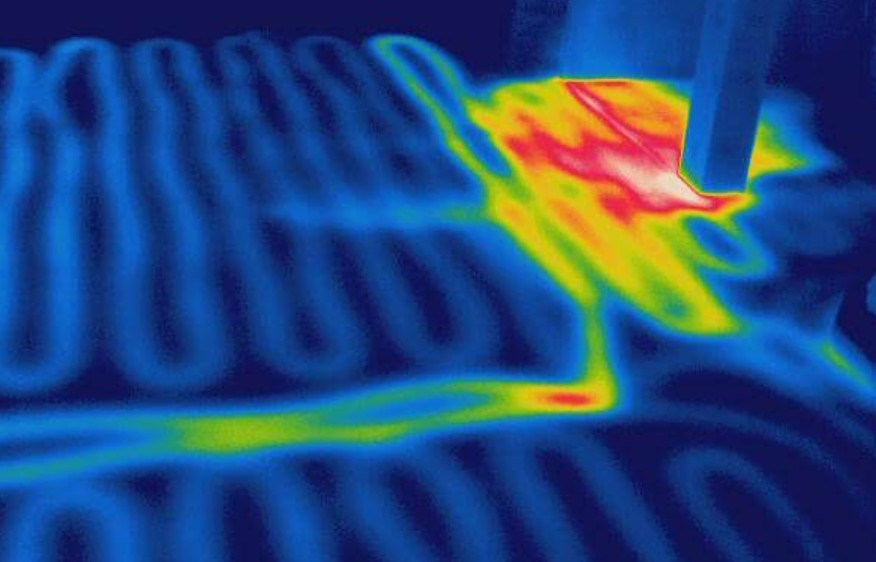
| Thermal imaging | A camera shows temperature differences on surfaces | Hot lines in slabs and walls, and damp areas cooled by evaporation | Sees surfaces only. Cold lines under thick concrete show little. |
| Acoustic listening | A ground microphone picks up the sound of water escaping under pressure | Slab leaks and buried lines | Traffic, HVAC and some plastic pipe make it harder |
| Tracer gas | The line is drained and filled at low pressure with 95% nitrogen and 5% hydrogen. The hydrogen works up through the ground to a detector. | Quiet leaks and long yard lines | Slower, and the line must be drained first |
| Line tracing | A transmitter shows the route and depth of a buried pipe | Yard lines, and pipe routes under slabs | Plastic pipe needs a transmitter fed into it |
| Inspection camera | A small scope through a small hole | Confirming a leak inside a wall cavity | Needs an opening, made only with your approval |
| Dye and flood tests | Colored water in a toilet tank, shower pan or drain | Leaks on the drain side | Not for pressurized supply lines |
Greensboro City Main Infrastructure Correlation
The city works the same way on its own mains. Greensboro Water Resources uses an acoustic correlation system that times leak noise between sensors on hydrants and valves. The maker reports the city has found more than 50 main leaks with it.
Where hidden leaks hide in Greensboro homes
The age and build of a house decide where a leak can hide and how long it stays hidden.
| House | Where the leak usually is | Why it stays hidden |
|---|---|---|
| Older homes on crawl spaces | Galvanized joints and aging copper under the floor | Water drips onto the ground cover and soaks away. Nothing shows upstairs until the framing is wet. |
| Ranches and townhomes on slabs | Copper lines in or under the concrete | The slab hides it. Only a hot-side leak warms the floor. |
| Homes from about 1978 to 1995 | Gray polybutylene fittings inside walls and ceilings, and blue polybutylene yard lines | The fittings fail inside finished walls. In townhomes, water can travel to the unit next door. |
| Two-story homes from the 1990s on | Upstairs bath supplies, shower valves, second-floor laundry, attic water heaters | The stain shows on a ceiling well away from the source. |
| Any home with a sprinkler system | Buried irrigation lines, zone valves, the backflow assembly | The system only runs on its schedule, so the meter only moves then. |
Read your own water data first
Greensboro's customer portal, GSO WaterWise, shows your daily water use and sends real-time leak notifications. The shape of the numbers says a lot about the leak.
| What the daily use shows | What it usually means |
|---|---|
| The same steady use every day, including days nobody was home | A constant leak on a pressurized line |
| Spikes on the same days each week | The sprinkler system, on its schedule |
| A slow climb over several weeks | A small leak getting bigger, often a toilet or a pinhole |
| One sudden jump that stays high | A fitting or line that has let go |
How To Speed Up Your Service
Logging into your Greensboro municipal water utility account before calling gives our dispatchers and testing plumbers invaluable historical data.