
Slab Leak Repair in Greensboro, NC:
Water Stopped Tonight, the Right Fix After
A warm spot on the floor, a hiss with every tap off, a water bill that doubled. We stop the water under your slab, confirm the leaking line, and price every repair option before any concrete is cut.
- Spot repair, tunneling, reroute or repipe, priced side by side
- Emergency slab leak repair at any hour, at the same rate
- Findings and photos in writing, ready for your insurer
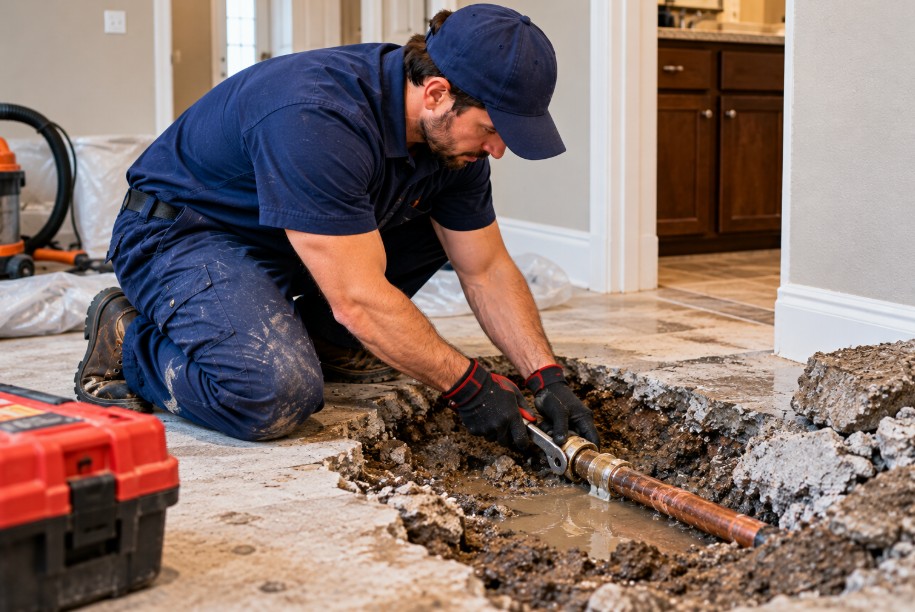
A slab leak is a pressurized pipe leaking inside or under your concrete floor. It will not dry out or stop on its own. Every hour it runs, water soaks the soil, the slab and the flooring on top, and Greensboro bills it twice: once as water, once as sewer.
We are a Greensboro plumbing company that repairs slab leaks around the clock. First we stop the damage. Then we help you pick the repair that suits your house, your floor and your pipe, not the one that is quickest to sell.
Signs of a slab leak
| What you notice | What it usually points to |
|---|---|
| A warm or hot patch on tile, laminate or concrete |
Hot Line Failure Hot-water line leaking under the slab |
| Water heater running more than usual, gas or power bill up | Hot water escaping somewhere you cannot see |
| Meter dial moving with every fixture off, or a GSO WaterWise leak alert |
Pressurized Leak A supply leak; under the slab if nothing shows inside the walls |
| Hissing or running-water sound low on a wall or under the floor | Pressurized line leaking at or below floor level |
| Damp carpet pad, cupping hardwood, dark grout, musty baseboards | Water wicking up through the slab |
| New floor cracks, or soil staying wet along one side of the foundation | Water moving under the slab and out to the edge |
| Weak pressure at every fixture | A large leak drawing off the supply |
Emergency slab leak: what to do right now
-
1
Shut off the main valve
In slab houses it is usually where the water line comes up through the floor: in the garage, a utility closet or near the water heater. If it will not turn, do not force it. Call us, or call Greensboro Water Resources dispatch at 336-373-2033; the meter box at the street belongs to the city.
-
2
Warm spot only? Isolate the hot side
Close the cold-water inlet valve on top of the water heater and set the heater to off or pilot. That stops the hot-water leak and keeps cold water running to toilets and the kitchen.
-
3
Water near outlets or floor plugs?
Switch that circuit off at the breaker.
-
4
Document meter and damage
Write down the meter reading and take photos of the wet floor, the meter and any damage. Your insurer will ask for them.
-
5
Clear rugs and furniture
Move rugs and furniture off the wet area. Leave the flooring in place until the leak is located; pulling it up early can mean replacing more than needed.
-
6
Call (743) 777-7432
Call (743) 777-7432. We answer 24 hours, and night calls cost the same as daytime calls.
Why slabs leak in Greensboro homes
Which houses have slabs
Many older Greensboro neighborhoods sit on crawlspaces or basements, so a slab leak is not a risk in every house. It is in ranch houses poured on grade, townhomes and condos, newer subdivisions, and in additions, sunrooms, converted garages and basement floors.
Pipe age
More than 37,000 Greensboro homes were built in the 1980s and 1990s, and about one in five predates 1960 (U.S. Census). Copper laid under slabs in that building wave is now 25 to 45 years old. In the oldest slab houses, supply pipe can be galvanized steel, which rusts from the inside out.
Pipe against concrete
Hot-water copper expands and contracts every time a tap runs. Where it touches gravel, rebar or the concrete itself, it wears through in a pinhole. That is why hot lines are the usual suspect.
Clay that moves
The North Carolina Geological Survey notes that shrink-swell clays occur across the Piedmont and that even small amounts of swelling can damage foundations. In the Triad's red clay, a dry summer followed by weeks of rain moves the soil under a slab edge, and the pipes in it move too.
Water pressure
The North Carolina plumbing code caps household water pressure at 80 psi. Above that, every joint and bend works harder. Pressure differs from street to street, so we test yours before recommending a repair.
Installation & water chemistry
Joints buried under the slab, kinked soft copper and pipe passing through concrete without a sleeve or wrap all fail sooner. Greensboro's water is soft, averaging 44 mg/L hardness with a pH around 8.1 in the city's 2023 water quality report. Chemistry is rarely the first suspect here; age, installation and soil movement usually matter more.
Drain lines count too
Not every slab leak is a supply pipe. Cast iron drains under older slabs corrode, and plastic drain joints can separate when the ground settles. A drain leak does not spin the water meter. It shows up as a sewer smell, slow drains or a damp floor near a bathroom. Drain and sewer lines are covered on our sewer line repair page.
Slab leak repair methods compared
| Method | How it works | Best fit | Trade-offs |
|---|---|---|---|
|
Spot Repair Spot repair through the slab |
Cut a small opening in the floor at the marked spot, replace the damaged section, sleeve it, patch the concrete | One leak, an otherwise sound pipe, a spot under tile or concrete that is easy to patch | Flooring at the opening must be replaced; another leak can follow elsewhere on old pipe |
|
Sub-Slab Tunneling Tunneling |
Dig beside the foundation and tunnel under the slab to the pipe | Leaks near an outside wall, under flooring you cannot replace | Heavy labor; the tunnel must be backfilled and compacted so no void is left under the slab |
|
Overhead Bypass Reroute (bypass) |
Abandon the leaking run and send a new line through walls, ceiling or attic | Hot-water lines, repeat leaks, leaks under hardwood or center rooms | Some drywall openings; attic lines must be insulated against Greensboro cold snaps |
|
Complete Repipe Whole-house repipe |
Replace all supply lines and take them out of the slab for good | Second or third leak, aging copper or galvanized pipe | Highest upfront cost; ends the slab problem for supply lines |
|
Internal Restoration Epoxy lining |
Dry the pipe and coat it from the inside | Pinhole leaks in a pipe that is otherwise intact and accessible at both ends | Not suitable for every pipe size, material or condition; we tell you if yours qualifies |
How we choose the repair for your house
When more than one method fits, we price each and tell you which we would pick and why. What decides it:
-
Hot or cold line: A hot line that has worn through in one place often has the same wear further along.
-
First leak or a repeat: A second slab leak in a few years usually means the pipe, not the spot, is the problem.
-
Where it is: Near an outside wall, tunneling may save the floor. In the middle of the house, a reroute is often simpler.
-
What is on top: Carpet rolls back. Tile can be patched if you have spares. Site-finished hardwood is hard to match.
-
Pipe material and age: 1990s copper and 1950s galvanized steel call for different answers.
-
The rest of the system: We pressure-test the other lines so you know whether another leak is waiting.
-
Your plans for the house: Selling soon and staying 20 years can point to different repairs.
What a slab leak repair visit includes
Stop the damage
Shut off or isolate the leaking line so the house can keep running.
Confirm the leak
Pressure-test to find which line is losing water, then pinpoint and mark the spot. See leak detection.
Check the system
Test house water pressure and the other lines under the slab.
Written options
Each repair that fits, with its price, before work starts. You choose.
Protect the house
Cover floors and furniture, and control concrete dust when the slab is cut.
Repair
Replace or bypass the damaged pipe. Pipe passing through concrete is sleeved or wrapped, as the plumbing code requires.
Test before closing
Pressure-test the repair with the floor still open.
Close up
Patch the concrete or close the tunnel and compact the backfill. Floor coverings are quoted separately or left to your flooring contractor.
Final check
Water back on, meter checked for movement with every fixture off, findings and work done in writing.
Permits, codes and floors in Greensboro
Permits & Inspections
Under North Carolina law (G.S. 160D-1110), replacing a pipe section with one of the same size usually needs no permit. A reroute or repipe changes the system's layout, so it does. We pull it with City of Greensboro inspections, or Guilford County for homes outside city limits, and the fee is on your quote.
-
House pressure at or under 80 psi, with a pressure-reducing valve where it runs higher.
-
Pipe passing through concrete sleeved or wrapped.
-
The repair pressure-tested before the floor is closed.
Townhomes and condos
In a townhome or condo, the slab may be common property, and one line can feed more than one unit. Tell your HOA or property manager before the floor is opened; we can talk to them directly.
Written diagnostics clearly delineate whether the failure lies within private lines or shared association risers to streamline HOA claim handling.
Your floor: preserving finishes
Keep any spare tile or flooring; a patch that matches is easier with it. If your hardwood or tile cannot be patched cleanly, ask us to price a reroute before anything is cut.
Insurance, water bills and city help
Homeowners insurance
Policies vary, so read yours. Many standard homeowners policies cover sudden water damage and the cost to tear out and replace part of the house to reach the leaking pipe, but not the pipe itself. Most exclude damage from continuous or repeated leakage over weeks or months, so report a slab leak as soon as you find it. We give you written findings, photos and meter readings for the claim.
Your water bill
The City of Greensboro is responsible for leaks up to your property boundary; the line into your house and everything under your slab is yours. Greensboro bills water and sewer volume on metered use, so water lost under the slab is charged on both, even though it never reaches the sewer. Ask Water Resources customer service (336-373-2489) whether any bill adjustment applies to your account. After the repair, check your daily use in GSO WaterWise to confirm it has dropped back to normal.
Renting?
If your landlord will not fix a leak that is raising your bill, the city points tenants to its Landlord-Tenant Dispute Program or Code Compliance.
Help with repair costs
Low-income homeowners can check the city's Home Repair GSO program, which offers grants of up to $20,000 for essential repairs. It opens applications in windows, so check the page for the next one.
What affects slab leak repair cost
You get a fixed, written price for each option before work starts. What moves that price:
| Factor | Why it matters |
|---|---|
| Repair method | A spot repair, a reroute and a whole-house repipe are very different jobs |
| Where the leak is | Near an outside wall or under a closet is simpler than mid-kitchen or under a tub |
| What is on the floor | Carpet rolls back; tile and hardwood take more care to open and protect |
| Number of leaks and pipe condition | One pinhole is one repair; worn pipe throughout points toward a repipe |
| Supply line or drain line | Drain repairs under a slab often mean more concrete removed |
| Permit | Reroutes and repipes need one; same-size spot repairs usually do not |
| Closing up | Concrete patching, tunnel backfill and drywall openings from a reroute |
Time of day does not change the price: nights and weekends cost the same as weekdays.
Whether your slab leak emerges on a Tuesday morning or 2 AM on a Sunday holiday, you receive the exact same transparent rates and upfront written options.
After the repair: drying, mold and the foundation
Drying
Concrete, carpet pad, baseboards and the bottom of drywall hold water long after the pipe is fixed. The EPA advises drying water-damaged materials within 24 to 48 hours to prevent mold. If more than a small area got wet, bring in a water mitigation company with dehumidifiers and moisture meters; we can tell you what we saw so they know where to start.
New flooring
Flooring installers check slab moisture before laying new floor. Do not rush it over a slab that is still wet.
The foundation
A leak that ran for months can wash out soil under the slab or swell the clay beneath it. If you notice wider cracks, sticking doors or floors that slope after the repair, have a structural engineer look. We are plumbers, not foundation contractors, and we will say so.
Confirm the fix
Watch your daily use in GSO WaterWise for the next couple of weeks. It should settle back to your normal pattern.