Sump pump repair · Greensboro, NC

Sump Pump Repair in Greensboro, NC:
Back Pumping Before the Next Band of Rain

A pit filling with no hum from the pump, a motor that runs and runs, water creeping across the basement floor. We get your pump working tonight, then fix whatever made it quit.

  • Basement and crawlspace pumps, pedestal or submersible
  • Emergency sump pump repair at any hour, at the same rate
  • Battery backups, alarms and discharge lines done right
Call (743) 777-7432
24/7 Rapid Response · Live Dispatch
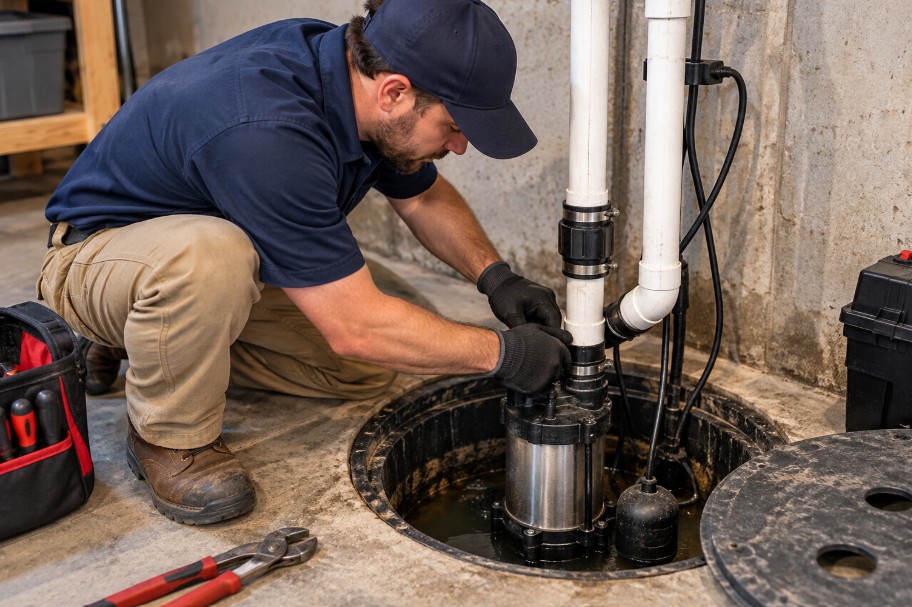
plumber repairing a sump pump in a Greensboro, NC basement
Greensboro Field Dispatch
Diagnostics & Repair Basement Sump System
Flow Tested
Submersible & Pedestal Units Float Switches · Check Valves · Backups
60-minute response
Licensed and insured in North Carolina
Most repairs finished on the first visit
Upfront quote, no after-hours surcharge

A sump pump sits in a pit at the lowest point of a basement or crawlspace and pumps out groundwater before it reaches your floor. It does nothing for months, then has to work hard through every heavy storm. That is when a weak pump gives out: in the middle of the rain, often with the power out.

Our plumbers take sump pump calls across Greensboro at any hour. Triad clay holds rain against foundations long after a storm passes, so a pump here has to keep up for days, not hours. We repair it, size it and set it up for that.

Foundation Hydraulics & Local Soils

Does your Greensboro home need a sump pump?

If any part of your house sits below the ground around it, water that gathers against the walls has nowhere to go but in. That covers full and partial basements, walk-outs on sloped lots and split-levels.

Crawlspaces & NC Residential Code

Crawlspace foundations are common across the Triad, and many have been closed (encapsulated). North Carolina's residential code requires a closed crawlspace to have mechanical drying, such as a dehumidifier. A dehumidifier cannot keep up with standing water, so many closed crawlspaces also have a drain or a sump pump at the low point.

Piedmont Clay & Backfill Pockets

The ground is a big part of the reason. Piedmont clay drains slowly. The soil dug out for a foundation and pushed back against it is looser than the clay around it, so rain soaks into that backfill and stays, pressing on the walls and seeping under footings. The North Carolina Geological Survey adds that Piedmont clays shrink and swell with moisture, opening and closing small gaps around foundations.

Triad Rainfall: 43" Normal vs. 64" Record

Then there is the rain itself. A normal Triad year brings about 43 inches. In 2018 the region topped 64 inches, a yearly record, and the September-to-February stretch that followed was the wettest fall and winter in records going back to 1903 (WFMY News 2). A pump that copes with a normal year can be overrun in a year like that.

Sub-Grade Pressure & Infiltration

Water gathering around sub-grade walls creates hydrostatic pressure. Without an active collection pit and functioning pump, groundwater forces its way through the cold joint between the footing and the wall, bubbling through hairline floor cracks or saturating crawlspace vapor barriers.

A pump is not always the answer. Gutters that dump at the foundation, downspouts that are not extended, and yards graded toward the house cause a lot of crawlspace water. If fixing those would solve your problem, we will say so.

Diagnostic Warning Signs

How to tell your sump pump is in trouble

Catching pump mechanical failure before a storm makes the difference between a dry basement and thousands in water remediation.
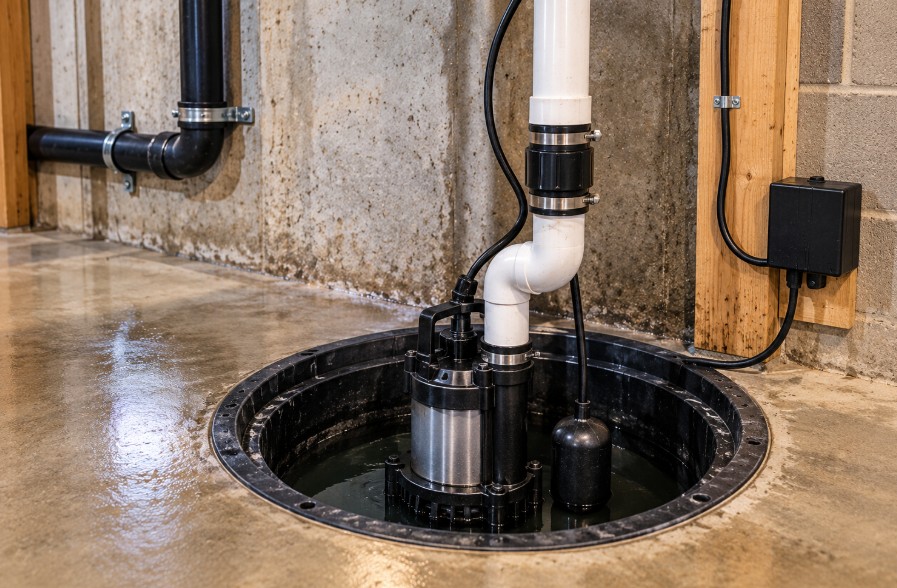
Sump pump and discharge piping in a Greensboro basement

Sump pump and discharge piping in a Greensboro basement

The 5-Minute Bucket Test

Slowly pour a bucket of water into the pit. The float should lift, the pump should start, empty the pit and switch itself off. If it stays quiet, leaves water behind or will not stop, get it looked at before the next storm.

In the pit Float & Basin

  • Water sits higher than normal and the pump never starts: The power is off, a breaker or GFCI has tripped, the float is stuck, or the motor is dead.
  • The pump starts and stops every few seconds: The float is set too tight, the pit is too small, or water is draining back through a bad check valve.

At the pump Motor & Impeller

  • It hums but no water moves: The intake or impeller is clogged, or the discharge line is frozen or blocked.
  • It runs nonstop in dry weather: A stuck float, a failed check valve, or a pump too small for the inflow.
  • Grinding, rattling or thumping: Worn bearings, debris in the impeller, or the discharge pipe slamming as the check valve closes.
  • Rust, scale or a burnt smell: An aging motor running hot.

Around the house Perimeter

  • Damp walls, a musty crawlspace, or water on the floor after rain: The pump is losing the race, or water is getting in somewhere it cannot reach.
Emergency First Response

Pump stopped and the water is coming up?

Follow these immediate steps to safeguard your electrical system, prevent structural flooding, and stabilize the basement while dispatch is en route.

1

Safety First: Power Outlets

If water has reached outlets, extension cords, the furnace or the electrical panel, stay out of it. Cut the power from a dry spot, or wait for help.

2

If the Pump is Silent

Check that it is plugged in, then reset the breaker or GFCI once. If it trips again, leave it off; the pump or its wiring has a fault. With the pump unplugged, check whether the float is caught on the pit wall, the cord or debris, and free it.

3

If the Power is Out

A battery backup should take over. Without one, a portable generator can run the pump, but only outdoors and well away from windows and doors. Never run one in a basement, garage or crawlspace. A wet-dry vacuum or buckets will buy time.

4

Pump Runs but Water Climbs

Cut what is feeding the pit. Turn downspouts away from the house and stop the washer or anything else that drains into it. The pump may be clogged or too small; call us.

5

While You Wait

Lift belongings off the floor and photograph the water and damage for your insurer. Documenting high-water marks helps support your claim.

Emergency Response Across Guilford County

We arrive equipped with submersible pumps, heavy-duty float switches, check valves, and temporary evacuation lines. No night or weekend surcharges: a 3 a.m. emergency costs the same as a 3 p.m. call.

Drain Line Cross-Check

Water coming up through a floor drain or toilet instead of the pit? That is usually a sewer backup, not a sump problem. See sewer line repair, or call us either way.

Regional Failure Analysis

What knocks sump pumps out in the Triad

Piedmont topography, clay siltation, electrical code quirks, and December cold snaps combine to test basement de-watering equipment beyond factory specs.

Weather

Summer thunderstorms, tropical remnants and winter ice knock out power across Guilford County, often while rain is still falling. A pump with no backup stops exactly when the pit fills fastest.

Wet years are hard on the motor too. A pump sized for a normal year can run for days on end after weeks of rain, and the heat that builds up shortens its life.

Cold does its damage outside. On December 24, 2022, Greensboro dropped to 5°F. A discharge line that holds water, or ends in a low spot, can freeze solid, and the pump then pushes against a plug of ice.

The ground

Groundwater here carries fine red clay into the pit. It settles on the bottom, coats the intake screen and wears the impeller. A pump standing on the pit floor in that silt clogs sooner than one raised on a stand under a sealed lid.

Buried discharge lines in clay also get crushed or packed with soil, and outlets disappear under mulch.

The equipment

Electrical code calls for ground-fault (GFCI) protection on outlets in basements and crawlspaces. It is a safety feature, but a GFCI that trips quietly in a crawlspace you never visit leaves the pump dead with no warning. A high-water alarm closes that gap. If the wiring needs work, we will tell you to bring in an electrician.

A tethered float can catch on the pit wall or the power cord, and a vertical float can stick in silt. Either way, the pump never gets the signal to start, or never gets the signal to stop. When the check valve fails, pumped water falls back into the pit and gets pumped again and again until the motor wears out.

The install

Missing check valves, no air relief hole on a submersible, a pit too small for the inflow, and a discharge pipe that sends water back toward the foundation all shorten a pump's life.

Correct installation requires dedicated check valve placement, union couplings for tool-free removal, and an engineered weep hole to prevent mechanical air locking.

Decision Matrix

Common sump pump repairs, and when to replace instead

We help you weigh a component repair against a complete unit replacement based on equipment age, motor condition, and long-term cost.

Problem The repair When replacement makes more sense
Float switch stuck or failed Free or replace the switch; reposition the float so it cannot catch The pump is old enough that the motor is next
Check valve failed or slamming Replace it, with a quieter valve if banging was the complaint Rarely; this is a straightforward repair
Intake or impeller clogged with silt Clean the pit and pump, raise the pump on a stand, fit a sealed lid The impeller or housing is cracked or worn
Pump runs but moves no water (air lock) Add the air relief hole the manufacturer specifies The motor has already overheated
Discharge line frozen, crushed or blocked Clear it or reroute it with steady downhill pitch and an outlet that cannot freeze or bury Not needed; the pump may be fine
Pump cannot keep up Fit a higher-capacity pump matched to the real inflow, or a larger basin Usually; this is a sizing problem
Motor dead or burning out Pump motors are sealed units and are not usually rebuilt Replace the pump
Hardware & Auxiliary Power

Pump types and backup options

Matching the right motor build, float switch type, and outage contingency to your basement layout and groundwater volume.

Primary pumps

Type How it works Good fit Trade-offs
Submersible Sealed motor sits in the pit, cooled by the water around it Finished basements, crawlspaces, heavy inflow Harder to reach for service; must be raised out of silt
Pedestal Motor stands on a column above the pit Narrow pits, light inflow, easy servicing Louder; motor exposed in a damp space

A cast-iron housing sheds heat better than plastic on a pump that runs for long stretches. Switches come as tethered floats, vertical floats or electronic sensors with no moving float. We pick the switch to suit the size of the pit.

Sizing. We time how fast your pit fills during rain, or after a test fill, and choose a pump that empties it with room to spare against the height and length of your discharge line. A pump that is too big short-cycles; one that is too small falls behind.

Backups

Option What it does Keep in mind
Battery backup pump A second pump on a battery takes over in an outage or if the main pump fails Run time depends on the battery and how hard it works; batteries need replacing
Water-powered backup Uses city water pressure to pump the pit, with no battery Needs good pressure and an approved backflow preventer, because it connects drinking water to the pit. Greensboro bills the water it uses for both water and sewer
Generator Runs the main pump in an outage Portable units outdoors only; a standby generator needs an electrician
High-water alarm Sounds, or texts your phone, when the pit rises too high The cheapest way to learn about a failure before the floor gets wet
Municipal Codes & Discharge Rules

Where the pumped water is allowed to go

Greensboro's Sewer Use Ordinance bars stormwater, groundwater, roof runoff and subsurface drainage from the city sewer unless specifically authorized. A sump pump piped into a laundry sink, floor drain or sewer cleanout breaks that rule, and the city can require an illegal connection to be removed. The rule exists because, in heavy rain, that extra water fills the sewer and feeds the overflows and backups it is meant to prevent.

Do Approved Discharge Paths
  • Send the water outside, where the ground falls away from the house, or through a buried line to daylight on a slope
  • Pitch the line so it drains completely after every cycle
  • End the line where the outlet stays open
  • Aim the outlet away from neighboring lots, driveways and sidewalks
Don't Prohibited & Hazardous Practices
  • Tie the pump into a sink, floor drain, cleanout or any sewer pipe
  • Leave dips or sags that hold water and freeze
  • Let it end under mulch, soil or a low spot that ices over
  • Dump it beside the foundation, where clay sends it straight back to the pit

Wastewater is a different job. If a washer or basement sink drains into your sump pit, that water belongs in the sewer through a sealed laundry or sewage pump, not in the yard. A basement bathroom needs a sealed sewage ejector, which is separate from a sump pump. Slow or backed-up basement drains are a drain cleaning job.

Field Protocol

How we handle a sump pump call

Our standard operating procedure delivers immediate water evacuation followed by root-cause diagnostics, precise sizing, and clean installation.

1

Immediate Dewatering

When we arrive, the first job is getting water out of the pit. If the pump can be brought back on the spot, we do that. If it cannot, we get the pit emptied and a working pump in place before we leave whenever possible.

2

Root-Cause Diagnostics

Before we quote, we work out why it failed. We check the power, breaker and GFCI, the float switch, check valve, intake and impeller, and walk the discharge line out to its end. We time how fast the pit refills so any new pump matches your house. We also look at where the water comes from. Gutters, downspouts and grading send a lot of water into pits, and water in the pit after a dry week can mean a leaking supply pipe, not groundwater (see leak detection). Then you get the repair, the replacement and any backup or alarm in writing, each with its price.

3

Code-Compliant Setup & Test

Before we leave, the pump is installed with a check valve, unions so it can be removed without cutting pipe, an air relief hole where the maker requires one, and a sealed lid. We fill the pit, watch a full cycle, confirm the water leaves the outlet where it should, and show you the bucket test and what your alarm or backup is telling you when it sounds.

Costs & Coverage

Paying for it, insuring it and keeping it running

What changes the price

A new float switch or check valve costs far less than a new pump. Beyond that, the bill depends on:

  • The pump's capacity and build (cast iron costs more and lasts longer under heavy use)
  • How hard it is to reach (a tight crawlspace takes longer than an open basement)
  • Whether the discharge line has to be rerouted or buried
  • Any battery, water-powered or alarm-only backup
  • Whether a new or larger pit has to be dug
The price is in writing before work starts, and nights, weekends and holidays do not change it.
North Carolina Insurance Guide

Insurance

The North Carolina Department of Insurance states that a standard homeowners policy does not cover water damage from sewer or sump pump backup.

North Carolina policies can add the Water Back-Up and Sump Discharge or Overflow endorsement (HO 04 84), which starts at a $5,000 limit that can be raised to $10,000, $15,000 or $25,000, according to the North Carolina Rate Bureau.

Flood is a separate peril: homeowners policies exclude it, and the national flood policy is silent on sump pumps. Ask your agent which of these you have before the wet season.

Preventative Schedule

A Greensboro sump pump calendar

Follow this 5-point seasonal maintenance routine to ensure your pit, float switch, backup battery, and discharge line never freeze or fail during extreme weather.

When What to do Why
Early spring Run the bucket test; clear silt from the pit and intake Spring storms are the first big test after winter
Before June 1 Test the backup by unplugging the main pump; replace batteries on the maker's schedule Hurricane season starts, and tropical rain often comes with outages
Late fall Walk to the outlet; clear leaves and mulch A buried outlet backs water up the line
Before the first hard freeze Check that the discharge line drains completely Standing water in the line freezes into a plug
After any heavy storm Listen for the pump cycling; look for water on the floor Clay keeps feeding the pit for days
Common Questions & Answers

Questions we hear about sump pumps in Greensboro

Straightforward answers regarding emergency thresholds, dry-weather running, battery backups, insurance endorsements, and city sewer rules.

Q1

Is a dead sump pump an emergency?

Yes, if water is rising in the pit or on the floor, or rain is forecast. A pump that fails the bucket test in a dry week can wait for a scheduled visit, but fix it before the next storm.

Q2

Why does my pump run when it has not rained?

Clay holds groundwater for days after a storm, so some running after rain is normal. Running through a long dry spell points to a stuck float, a check valve letting water fall back, or a leaking supply pipe feeding the pit.

Q3

How long does a sump pump last?

It depends on how hard it works. A pump that runs through every wet spell wears out much sooner than one that rarely switches on. Grinding, overheating and constant running are signs it is near the end.

Q4

What can I check myself?

That it is plugged in, that the breaker and GFCI are on, that the float moves freely, and that the outlet outside is clear. Leave wiring and discharge piping to a pro.

Q5

Do I need a battery backup?

If you have finished space below grade, yes. Outages and heavy rain arrive together, and a backup pump is what keeps the floor dry during one.

Q6

Can my sump pump drain into the sewer?

Not in Greensboro. City rules bar groundwater and subsurface drainage from the sanitary sewer. The water has to be discharged outside, away from the house.

Q7

Does my crawlspace need a sump pump?

Only if water collects there that gutters, downspouts and grading cannot keep out. We will tell you if those fixes would do the job first.

Q8

Will homeowners insurance pay for sump pump water damage?

Not under a standard North Carolina policy. You need the water back-up and sump discharge or overflow endorsement, so check your policy now.

Q9

Can you install a sump pump where there is none?

Yes. We dig the pit at the low point, set a sealed basin and pump, and run the discharge line outside.

Q10

My pump bangs every time it shuts off. Is it failing?

Usually not. That is the check valve slamming shut as water stops. A quieter valve usually fixes it.

Need emergency de-watering tonight? Our licensed Greensboro emergency plumbing technicians answer 24/7. Call (743) 777-7432 for rapid dispatch with zero after-hours surcharges.

Scroll to Top