
Main Water Line Repair in Greensboro, NC: From the Meter to Your Wall
A soggy strip of lawn, a meter that never rests, pressure that dropped overnight. We find the break in the pipe between your meter and your house, dig only where we need to, and repair or replace it with a price agreed first.
- Repairs and full replacements, open trench or trenchless
- Emergency main line repair at any hour, at the same rate
- NC 811 locate and any permit handled for you
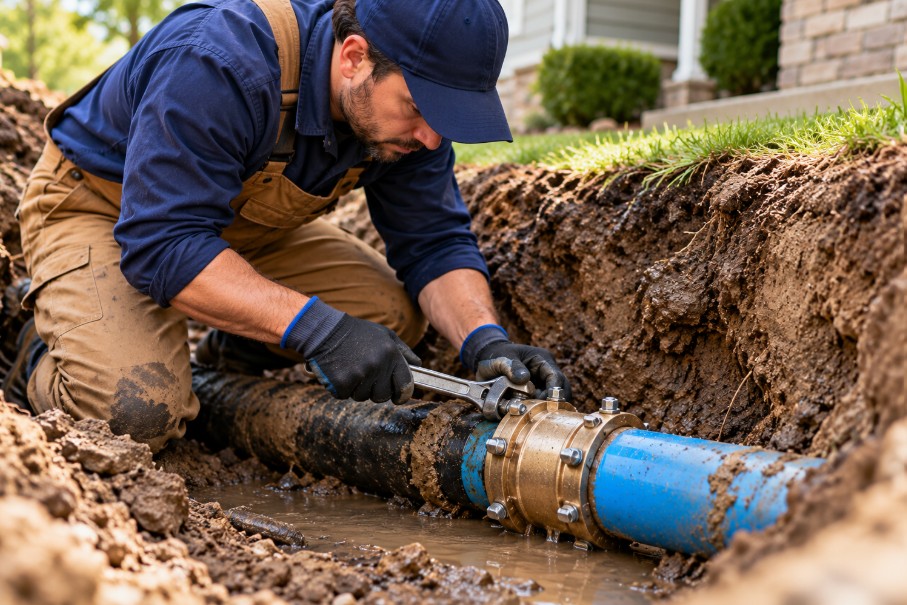
Guilford County Ground Excavation & Relining
From city meter pit connection through red clay strata to the foundation penetration, we resolve yard breaks without tearing up unnecessary landscape.
Your main water line is the buried pipe that carries city water from the meter at the street into your house. Everything that flows through your taps passes through it first. When it cracks, every gallon that leaks is metered and billed to you, and the soil around it turns to mud.
We are a Greensboro emergency plumbing company, and this line is the one job where knowing the ground matters as much as knowing the pipe. Red clay, tree roots, 1980s plastic and cold snaps that drop into single digits all shape how these lines fail here and how we fix them.
Your main water line vs. the city's water main
The two names sound alike, but they belong to different owners.
-
Water main: the large pipe under the street. It belongs to the City of Greensboro.
-
Meter and meter box: usually near the street or property line. The city installs and owns these.
-
Main water line (service line): the pipe from the meter, across your yard, to your house. It is yours.
-
House shutoff valve: where the line enters the house, in a crawlspace, basement, garage or utility closet. From here inward, it is your house plumbing.
| Where the water is | Likely owner | Who to call |
|---|---|---|
| Coming up through the street or curb, or the whole street loses water | City | Greensboro Water Resources dispatch, 336-373-2033, 24 hours |
| Inside or around the meter box | Could be either side of the meter | City dispatch first; if they find the leak on your side, call us |
| Wet strip or puddle between the meter and the house | You | Us: (743) 777-7432 |
| At the wall where the line enters, or in the crawlspace | You | Us: (743) 777-7432 |
Signs your main water line is failing
| What you notice | What it usually means |
|---|---|
| A soggy or sunken strip of lawn between the street and the house, wet even in dry weather | A leak in the buried line; water follows the loose soil of the old trench |
| Grass that stays greener along one line across the yard | A slow leak feeding the roots |
| Water bubbling up, or a hole opening in the yard or driveway | A larger break washing soil away |
| Pressure drops at every tap at once, not just one | Water escaping before it reaches the house, or a pipe narrowed by rust |
| Brown or rusty water at every faucet | Old galvanized steel corroding inside |
| Hissing at the meter box or where the pipe enters the house | Water forced through a crack or failed joint |
| Standing water in the crawlspace by the foundation wall | A leak where the line comes through the wall |
| A GSO WaterWise leak alert, or a bill that jumped with no change in use | Continuous flow somewhere after the meter |
A five-minute test you can do
-
1
Turn off every tap, appliance and irrigation zone.
-
2
Look at the meter. If the small leak indicator or the dial is still moving, water is leaving somewhere.
-
3
Close your house shutoff valve and check the meter again.
-
4
Still moving? The leak is in the line between the meter and the house: your main water line. Stopped? The leak is inside the house; see water leak repair or leak detection. A warm spot on a concrete floor points to a slab leak.
Emergency main line break: what to do now
Why main water lines fail in Greensboro
The age of the pipe
Greensboro has about 112,000 water service lines, and roughly 30,000 of them went in during the 1980s, according to the city. The material in your yard usually tracks when the house was built:
| When the house was built | Common service line material | How it tends to fail |
|---|---|---|
| Before 1960 | Galvanized steel; lead is possible on the private side of older homes | Rusts from the inside: brown water, falling pressure, leaks at threaded joints |
| 1960s–1970s | Copper | Cracks at fittings when soil settles, or is crushed by roots or heavy loads |
| Late 1970s–1995 | Polybutylene, often blue, gray or black at the meter | Cracks at fittings and along the pipe with age |
| Mid-1990s on | Polyethylene, PEX or copper | Mostly outside damage: digging, roots, poor bedding, loose fittings |
These are patterns, not rules. Many houses have had a line replaced, so we check what is actually in the ground before we quote.
Cold snaps
Greensboro winters are mild until they are not. The temperature fell to 5°F on December 24, 2022, and January 2018 logged 202 hours at or below freezing. The North Carolina plumbing code requires a water service pipe to be buried below the frost line and at least 12 inches deep. Lines laid shallower, along with the riser where the pipe comes up into a crawlspace, are where freezes do their damage. If a freeze has already split a pipe inside the house, see burst pipe repair.
Red clay
The North Carolina Geological Survey notes that shrink-swell clays occur across the Piedmont. Triad clay hardens and shrinks in a dry August, then swells after weeks of rain. A buried pipe gets pulled and pushed with it, and the stress lands on joints and fittings.
Roots
Roots rarely break into a pressurized water line the way they invade sewer and drain pipe. They wrap and squeeze it, lift it, or grow into the gap once a small leak is feeding them. Mature oaks and maples near the line are the usual culprits.
Pressure
The code limits pressure inside the house to 80 psi and calls for a pressure-reducing valve when supply pressure runs higher. Excess pressure strains every joint on the line and inside the house, down to the relief valve on your water heater, and a failed reducing valve can go unnoticed for years.
Damage from above
Fence posts, irrigation trenches, utility work, driveways poured over the line and trucks parked on the lawn all crack or crush service lines. So does a line laid in rocky backfill with no bedding.
Lead and galvanized service lines in Greensboro
Under the federal Lead and Copper Rule Revisions, Greensboro built an inventory of every service line in its system and published it on a Service Line Inventory Dashboard in October 2024. What the city reports:
-
No lead service lines have been found in its field investigations, and it knows of none between the mains and the meters.
-
Lead pipe may still exist on private property, especially at older homes and businesses.
-
The city will pay to replace galvanized lines classed as "galvanized requiring replacement" (GRR), from the meter to the building. It began contacting those owners in early 2026 to confirm the pipe by vacuum excavation, and plans to replace verified lines starting with the oldest buildings in late 2026.
-
If your building predates 1986 and the line has never been replaced, you can request a lead test kit from the city.
How to tell what you have, at the point where the pipe enters the house:
Not sure? We will identify it on any visit and tell you what it means.
Repair or replace: the methods compared
| Method | How it works | Best fit | Trade-offs |
|---|---|---|---|
| Spot repair | Dig at the leak, cut out the damaged section, join new pipe | One leak in a newer, otherwise sound line | On old galvanized or polybutylene, the next leak is often close behind |
| Open-trench replacement | Dig from the meter to the house, lay new pipe on clean bedding, backfill and compact | Open lawn, aging pipe, repeat leaks | A strip of lawn is dug up and needs reseeding or sod |
| Directional boring (trenchless) | Dig a pit at each end, bore a path underground, pull the new pipe through | Lines under driveways, walks, mature trees or finished landscaping | Every other buried utility must be marked first; rock can push the bore off course |
| Pipe pulling (trenchless) | Pull new pipe along the old pipe's path, splitting or dragging out the old line | A straight, continuous old line in a reachable path | Not every old pipe or route allows it |
| New route | Abandon the old line and run a new one along a better path | An old line now under an addition, patio or driveway | A longer run; the old pipe is capped at both ends |
When to repair and when to replace
We repair a single break in a newer line. We recommend replacement when the pipe is galvanized steel or polybutylene, when this is the second or third leak, or when pressure and water color say the inside of the pipe is closing up. You get both prices so you can weigh them yourself.
What goes in the ground
The code allows copper (not the thin Type M), PEX and polyethylene for buried water service, with a minimum size of 3/4 inch. A long run, a bigger household or an irrigation system can justify 1 inch. With plastic pipe, we lay a tracer wire alongside so the line can be located later without guessing. At the house end, we fit a new shutoff valve and test pressure, adding a pressure-reducing valve if the supply runs over 80 psi.
Digging in Greensboro: locates, permits and your yard
NC 811 before any shovel
North Carolina law requires a locate request through NC 811 before digging, normally three working days ahead. Gas, power, cable and fiber lines are marked with paint and flags. In a genuine emergency, 811 takes emergency locate requests. We place the call. If a gas line is ever hit or you smell gas, leave the area and call Piedmont Natural Gas at 800-752-7504.
What 811 does not mark: Private lines you installed are not on any map: irrigation, landscape lighting, a gas line to a grill or pool heater, an invisible dog fence, a cable to a detached garage. Tell us about them before we dig.
Code requirements we build to:
-
Pipe below the frost line and at least 12 inches deep.
-
At least 5 feet of earth between the water line and the sewer line, or the water pipe on a ledge at least 12 inches above the sewer in a shared trench.
-
Pipe bedded in clean fill, not rocky clay chunks, so stones cannot press on it.
-
Pressure-tested before the trench is closed.
Permits
Whether a water service job needs a permit depends on the scope. We check with City of Greensboro inspections, or Guilford County for homes outside city limits, and pull the permit when one is required. The fee is on your quote.
Driveways, trees and lawns
We bore under concrete instead of breaking it wherever the route allows, and dig wide of large trees to spare their roots. Trenches are backfilled and compacted in layers so they do not sink after the first hard rain. Seed or sod is on the quote if you want it.
What a main water line repair visit includes
-
1
Stop the water
Close the house valve, and bring in city dispatch if the meter needs to be shut.
-
2
Confirm whose leak it is
A meter test and a look at the meter box settle whether it is your line or the city's.
-
3
Find the break
We trace the line's route across the yard and pinpoint the leak before digging. See leak detection.
-
4
Check the pipe and pressure
We identify the material, test house pressure and look at the shutoff valve.
-
5
Written options
Repair or replace, trench or trenchless, each with its price. You choose.
-
6
Locates and permit
We request the NC 811 locate and pull a permit when one is required.
-
7
The work
Dig or bore, repair or lay new pipe, and connect at the meter side and the house.
-
8
Flush and test
We flush out dirt from the open line and pressure-test it before anything is buried.
-
9
Close up
Backfill, compact, rake out the topsoil, turn the water on and confirm the meter sits still with every tap off.
Cost, insurance and help paying
What sets the price:
| Factor | Why it matters |
|---|---|
| Repair or replacement | Fixing one break and replacing the whole line are different jobs |
| Length and depth of the run | A house set far back from the street means more pipe and more digging |
| What is on top | Lawn is simple; driveways, walks, patios and mature trees push toward boring |
| Pipe material and size | Upsizing to 1 inch, or replacing galvanized, adds material |
| Ground conditions | Hard clay and rock slow digging and boring |
| Permit and restoration | Permit fees, seed or sod, and any concrete work |
You get a written price for each option before work starts, and nights and weekends cost the same as weekdays.
Zero emergency after-hours premiums or surprise line items. You review the exact quote before any shovel breaks ground.
Insurance
The city notes that basic homeowners insurance often excludes exterior service lines. Some insurers sell a service line endorsement that pays for digging and repairing a buried line up to a set limit. Ask your agent whether you have one before the next break, not after.
City-linked options
-
Galvanized line replacement: if the city's inventory classes your line as galvanized requiring replacement, the city plans to replace it at its cost.
-
Service line plans: the city partners with Service Line Warranties of America (SLWA), an independent company that sells optional plans covering exterior water and sewer lines. Read the terms and limits before you buy.
-
Home Repair GSO: low-income homeowners can apply for grants of up to $20,000 for essential repairs when the city opens an application window.
Your water bill
Greensboro bills both water and sewer on metered use, so a yard leak is charged twice, even though that water never reaches the sewer. After the repair, ask Water Resources customer service (336-373-2489) whether any bill adjustment applies, and watch GSO WaterWise to confirm your daily use is back to normal.
Main water line repair in Greensboro: common questions
Straightforward answers to property lines, city meters, galvanized pipe replacement programs, yard preservation, and emergency protocols across Guilford County.
Who is responsible for the water line from the street to my house?
The City of Greensboro handles the main, the meter and leaks up to your property boundary. The line from the meter to your house is yours to repair.
Is a main water line leak an emergency?
Yes, if water is surfacing in the yard, washing out soil, or your pressure has collapsed. A slow leak that only shows on the meter can wait for a scheduled visit, but you pay for every gallon until it is fixed.
Can I still use water while I wait?
If the leak is slow and nothing is washing out, you can open the house valve briefly to fill containers or run a load. Keep it closed the rest of the time.
How long does the repair take?
A single break in a reachable spot is often fixed the same day once utilities are marked. A full replacement depends on the length of the run, the method and the ground. You get a time estimate with your quote.
Will you tear up my whole yard?
Not necessarily. A spot repair needs one hole. For a replacement, boring or pipe pulling can run the new line under the lawn, driveway and trees with a pit at each end.
How deep is my water line?
The code calls for at least 12 inches and below the frost line. Older lines vary, and some were laid shallower than they should have been.
My line is galvanized. Should I wait for the city to replace it?
Check your address on the city's service line dashboard first. If it is classed as galvanized requiring replacement, the city plans to replace it at its cost. If it is leaking now, we repair what is needed to restore water and leave the replacement decision to you.
Will the city fix a leak at the meter?
If the leak is on the city's side of the meter, yes. Call Water Resources dispatch at 336-373-2033. If they find it on your side, call us at (743) 777-7432.
Can a main line leak damage my foundation or crawlspace?
It can. Water often runs along the pipe trench toward the house and soaks the soil by the foundation or seeps into the crawlspace. Fixing the leak quickly limits that.
Can you replace the sewer line at the same time?
Yes. If both lines are old, one dig can serve both: the code allows a shared trench with the water pipe on a ledge above the sewer. See sewer line repair.
Need immediate confirmation of where your leak is located? Our emergency crews isolate the main shutoff valve and verify city meter dials on arrival. Call (743) 777-7432 for 24/7 service with zero after-hours fees.