
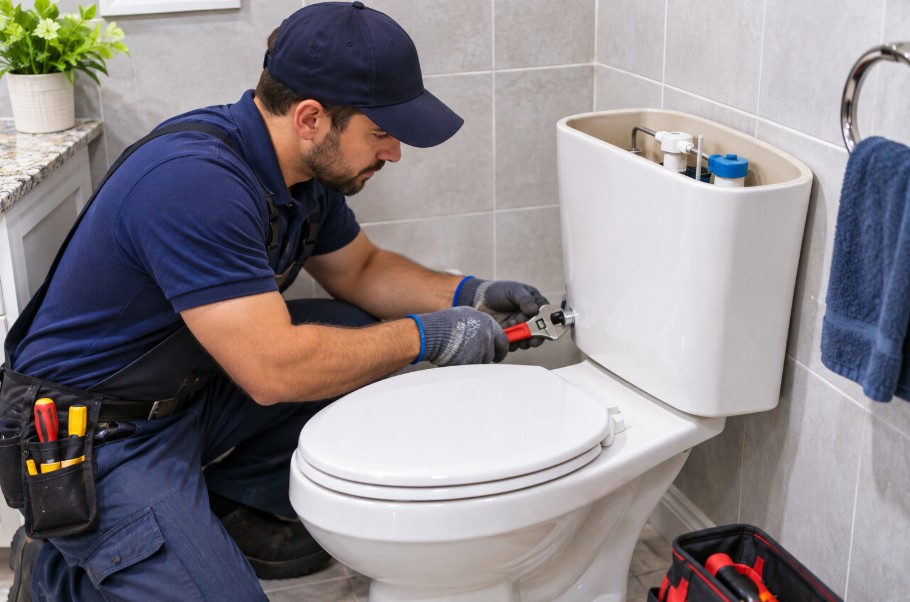
Clogged Toilet Repair in Greensboro, NC: Cleared Tonight, Fixed for Good
Water rising to the rim, a bowl that drains in slow motion, a toilet you have plunged three times this month. We clear the clog without scratching porcelain or flooding the floor, then tell you why it happened.
- Overflowing toilets handled any hour, at the same rate
- One-toilet clogs and whole-house drain backups
- Straight advice on whether your toilet is the problem
Bowl about to spill? Lift the tank lid and push the flapper closed, then call.
Plenty of clogged toilets are a wad of paper or something that should never have been flushed, and a good plunger handles them. The ones worth a call are the clogs that will not budge, the toilet that clogs every week, and the bowl that rises when someone runs the shower. Those point past the toilet: to its trapway, the drain under the floor, or the sewer line out to the street.
We are a Greensboro emergency plumbing team for the moments when the plunger has stopped working. We clear the blockage, and we tell you honestly whether the trouble is the toilet, the pipes, or what is being flushed.
Is it the toilet, or the whole drain?
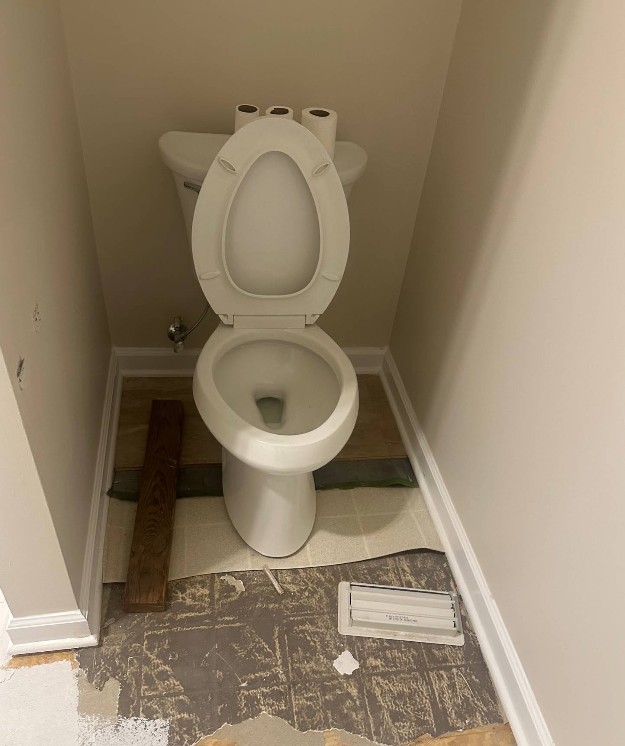
A few questions sort out most clogs before anyone picks up a tool.
Is this the only fixture acting up?
If the sinks, tub and shower all drain normally, the blockage is in the toilet itself or the short pipe right under it. That is the easiest kind to clear.
Do other drains react when you use it?
Water rising in the tub when you flush, the toilet bubbling while the washer drains, or a basement shower or floor drain filling up all point to a blockage in the main drain or sewer line. Plunging the toilet will not reach it and can push sewage out of the lowest drain in the house. Stop using water and see drain cleaning or sewer line repair.
Does it get worse when it rains?
A toilet that slows down or gurgles during heavy rain often has an older sewer line with cracks or root-filled joints that let groundwater in. If sewage is coming out of the cleanout at the edge of your yard or a manhole in the street, the problem may be on the city's side. Call Greensboro Water Resources dispatch at 336-373-2033, day or night.
On septic?
Some homes in Guilford County outside city limits run to a septic tank instead of a city sewer. If every drain is slow and the ground over the drain field is soggy or smells, the tank may be full. The county health department recommends pumping every three to five years.
Toilet overflowing right now?
In the first 30 seconds
- Do not flush again. A second flush sends another tank of water into a bowl that cannot drain.
- Lift the tank lid and push the flapper down (the rubber seal at the bottom of the tank). That stops water entering the bowl. Lift the float or fill arm to stop the tank refilling.
- Turn the shutoff valve behind the toilet clockwise until it stops. If it will not move, close your home's main water valve.
In the next few minutes
- Treat the water as sewage. Wear gloves, keep children and pets out of the room, and wash up afterward.
- Soak up the spill with old towels before it runs under the vanity or into the hallway carpet.
- On an upper floor? Check the ceiling below. If water is dripping near a light fixture, switch that circuit off at the breaker.
- If other drains are backing up too, stop all water use in the house: no showers, laundry or dishwasher until the line is cleared.
Then call (743) 777-7432. Our emergency plumbers come out for an overflowing toilet at 2 a.m. for the same price as at 2 p.m.
Clearing it yourself: what works and what backfires
Start with the right plunger
A toilet needs a flange plunger: the kind with an extra rubber sleeve that folds out from the cup and seals into the drain opening. The flat cup plunger under most kitchen sinks cannot seal in a toilet bowl and mostly splashes.
Plunge with a seal, not with force
- Make sure there is enough water in the bowl to cover the cup. Add some from a bucket if needed, or bail out some if it is near the rim.
- Tilt the plunger in so the cup fills with water instead of air, then seat the flange in the drain hole.
- Make the first push gentle, then pump firmly in and out 15 to 20 times without breaking the seal.
- Pull it away sharply and watch the water. Two or three rounds often clear a paper clog.
If the plunger does not do it
A closet auger, a short hand-cranked cable in a curved tube with a rubber sleeve, reaches through the toilet's trapway without scratching the bowl. Feed the cable in, crank clockwise until it bites or breaks through, then pull it back. A squirt of dish soap followed by a bucket of hot tap water, left for 15 minutes, can help soften a paper or waste clog first. Do not use boiling water: the sudden heat can crack porcelain.
What makes it worse
- Chemical drain cleaners. They rarely reach a toilet clog, they sit in the bowl, and they splash on whoever plunges next, including your plumber. Mixed with other cleaners, some release toxic fumes.
- Coat hangers and sink snakes. Bare wire leaves permanent gray scratches in the porcelain.
- Plunging when other drains are backing up. The blockage is further down, and the pressure pushes sewage out somewhere else.
- Plunging out a dropped object. A phone, toy or toothbrush gets wedged deeper with every push. Leave it, and call us to retrieve it, sometimes by lifting the toilet off the floor.
If two or three honest rounds with a flange plunger and an auger have not cleared it, stop. More force tends to break the wax seal or crack the toilet.
Why toilets clog in Greensboro homes
When the toilet was made
Toilets sold before 1994 typically used 3.5 gallons or more per flush. The Energy Policy Act of 1992 capped new residential toilets at 1.6 gallons starting January 1, 1994, and many early low-flow models flushed poorly until manufacturers redesigned them. Greensboro added more than 37,000 homes in the 1980s and 1990s, so plenty of houses here were built with, or upgraded to, those first-generation toilets. If yours dates from then and clogs often, the toilet may simply be the problem.
What is under the floor
About one Greensboro home in five was built before 1960. Drains from that era are often cast iron, which builds up rough scale inside as it corrodes, and the yard line is often clay pipe with a joint every few feet. Paper catches on the scale, and the pipe slowly narrows. A modern low-flow toilet bolted onto an old, wide drain also sends less water down the line to carry waste along, so it can settle partway to the street.
The trees in the yard
Mature oaks and maples send roots toward any joint that leaks a little moisture. Once inside an old clay or cast-iron line, they form a net that catches paper, and the toilet, which sends the most solids down the line, is often the first fixture to back up.
The clay and the rain
Piedmont clay swells when wet and shrinks when dry. Over the years that movement can make an old sewer line sag, leaving a low spot where water and paper sit. In heavy rain, cracked lines also take in groundwater, which is why some Greensboro toilets gurgle or flush slowly only during storms.
The water (good news)
Greensboro's water is soft, averaging 44 mg/L hardness in the city's 2023 water quality report. Mineral scale clogging the rim holes, a common cause of weak flushes in hard-water cities, is less often the culprit here. A weak flush is more likely a low tank water level, a flapper closing too early, or a partial clog.
What goes down it
When wipes and paper towels replaced toilet paper during 2020, Greensboro's operations manager told WFMY News 2 that clogs in the city system had risen 10 to 15 percent. Those same items stop in house drains first.
What should never go down a Greensboro toilet
Greensboro Water Resources looks after more than 1,400 miles of sewer pipe, and its message on wipes is blunt. The department's video is titled "All Wipes Clog Pipes," and its director has said that wipes labeled "flushable" gather together and "create a plug or a blockage." Anything that clogs a city sewer main clogs a 3-inch toilet drain sooner.
| Keep out of the toilet | Why it causes trouble | Where it goes instead |
|---|---|---|
| Wipes of any kind, including "flushable" | They do not break apart like toilet paper and knot together in pipes | Trash |
| Paper towels and facial tissue | Made to stay strong when wet | Trash |
| Pads, tampons and applicators | Swell and lodge in the trapway | Trash |
| Cotton swabs, dental floss, hair | Snag and form a net that catches paper | Trash |
| Cat litter, even "flushable" brands | Clumps into a solid mass | Trash |
| Cooking grease and oil | Hardens as it cools and coats pipes | Cool it, seal it in a can, put it in the trash |
| Diapers, condoms, bandages | Do not break down | Trash |
| Medicines | Not a clog risk, but they pass into waterways | A pharmacy or law enforcement take-back box |
Even toilet paper causes clogs in a big wad. With kids, or with a first-generation low-flow toilet, flushing partway through helps. On septic, skip the additives and stick to the pumping schedule.
How we clear it, depending on where the clog sits
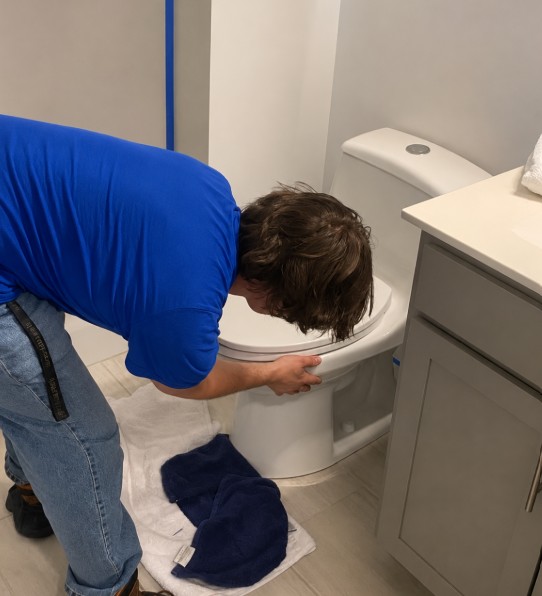
We start with the gentlest tool that can reach the blockage and only step up when we have to.
In the bowl or trapway
A professional flange plunger or a closet auger with a protected head usually clears a clog in the toilet itself without marking the porcelain.
An object wedged inside
Toys, phones, bottle caps and toothbrushes often will not come back through the bowl. We shut the water off, lift the toilet off the floor, push or pull the item out from underneath, then reset the toilet on a new wax ring and bolts and test it for leaks.
In the drain under the floor
With the toilet lifted, a cable machine runs straight down the drain from the floor opening. Where there is an accessible cleanout, we go in from there instead.
In the main line
When several fixtures are involved, we clear the line from the main cleanout with a heavier cable. A camera inspection then shows what caused it: roots, a sag holding water, scale in old cast iron, or a broken pipe. Heavy grease or root buildup in a sound pipe may call for hydro jetting through our drain cleaning service; a broken or collapsed line is a sewer line repair.
Whatever the method, we flush the toilet several times with paper, run the other fixtures to make sure the whole system drains, clean and disinfect the work area, and tell you what we pulled out and why it got stuck.
A toilet that keeps clogging
One clog is bad luck. A clog every week or two has a cause, and it is usually one of these.
- The tank does not fill high enough. If the water sits well below the line marked inside the tank, every flush is a weak one. Adjusting the fill valve fixes it.
- The flapper drops too soon. A worn flapper or a chain with too much slack cuts the flush short. A new flapper costs little and restores the full flush.
- The half flush is doing a full flush's job. On a dual-flush toilet, the small button is meant for liquids only. Using it for solids leaves waste sitting in the trapway.
- Something is stuck in the trapway. A comb or small toy lodged inside lets water pass but catches paper every time. Lifting the toilet is the only way to find it.
- The roof vent is blocked. Leaves or a bird's nest in the vent pipe starve the drain of air, so the flush is weak and the bowl gurgles.
- The drain line is the problem. Roots, a sag or old cast-iron scale downstream will keep catching paper however good the toilet is. A camera inspection settles it.
- The toilet is the problem. A first-generation 1.6-gallon model may never flush well. Toilets carrying the EPA WaterSense label use no more than 1.28 gallons and are independently certified for flush performance, so a newer toilet can use less water and still clog less. Pressure-assisted models, which use a sealed tank to push the flush, are another option for a toilet that gets heavy use.
If the toilet has started to rock, or water appears around the base after a clog, the wax seal underneath has likely failed. That needs resetting before it rots the subfloor; see water leak repair. A cracked bowl or tank always means replacement.